Forage
Design ideas, foraged daily
-
 Information design / label placement
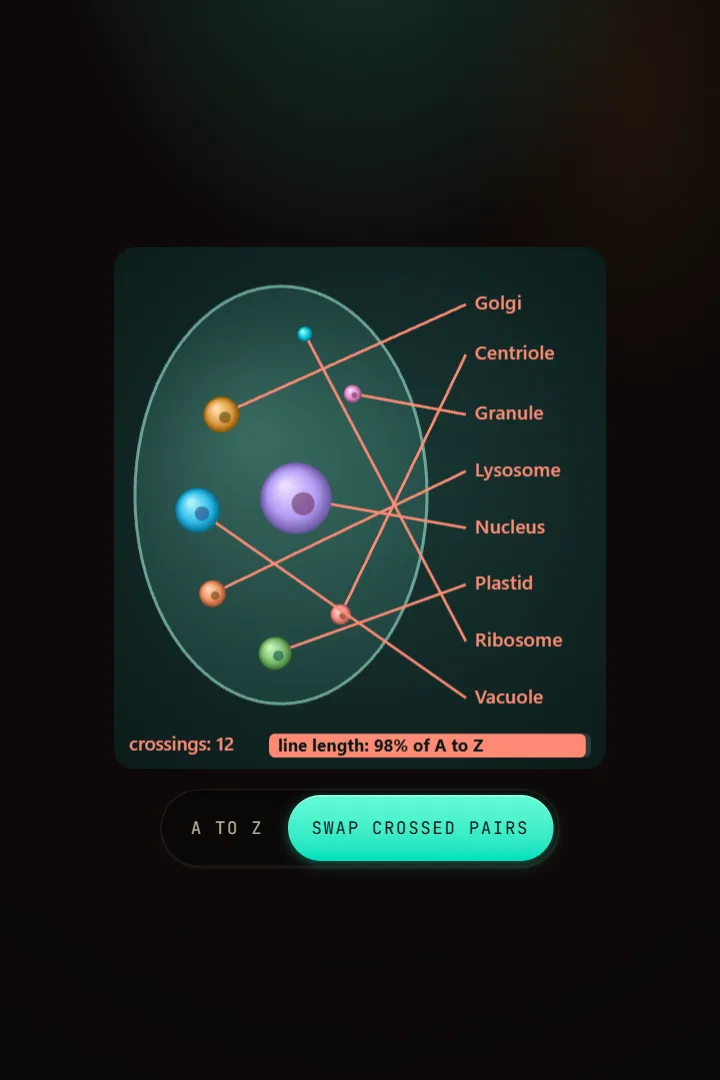
Label placement: where a name goes on a crowded map
Names on a dish of Sporeling, a made-up colony game. You drag cells onto the eight numbered seats round one cell and watch its name hop to the best seat left, slide the names on a family tree of strains from in line with their branches to above their cells and watch the hidden share of branch fall to nothing, set three ways of placing names loose on a dish of up to 36 cells and compare how many each leaves overlapping, zoom a dish while names are re-placed every frame or hold one seat and one start zoom each, and drag the parts of one large cell while their leader lines swap names until none cross.
-
 Sculpture / surface modelling
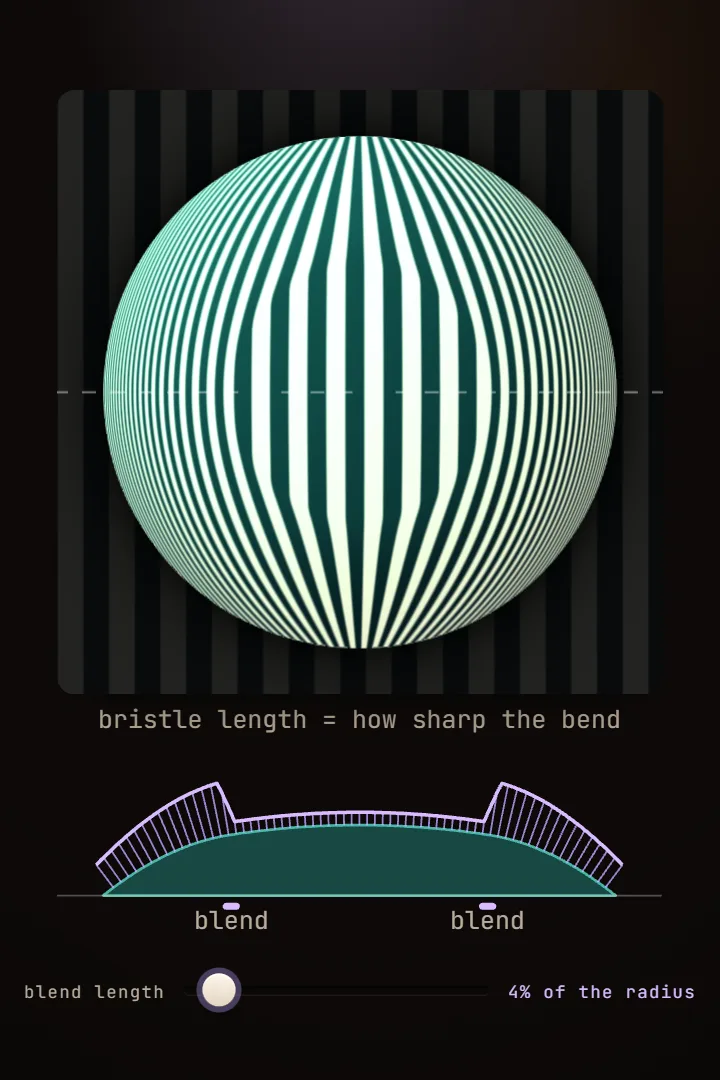
Surface continuity: why a smooth surface still shows a seam
A glossy cell on a dish, seen from above under a row of strip lights and drawn by one fragment shader, with a cut through its middle drawn underneath. You press a dent 3% of the cell's height into it and watch every reflected stripe bend, open and close the angle where its cap meets its skirt until the stripes stop breaking, lengthen the blend between the two until the stripes stop kinking, turn the gloss down to matte to see which joins a rough material hides, rebuild the cell as a mesh with one normal per face, shared normals or one split edge, and ease the bend into the corner of this site's own card.
-
 Interaction design / progressive disclosure
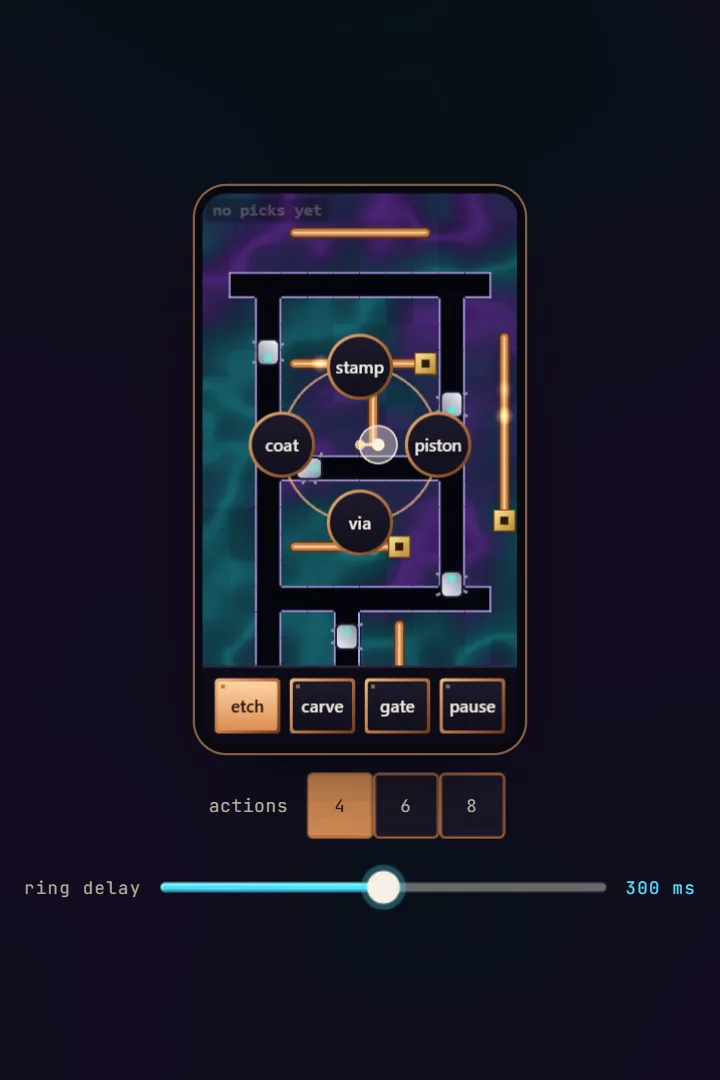
Controls on demand: where the rest of the controls wait
A living chip on a phone: builder machines crawl a silicon slab doing the work you mark, and the game has 24 actions but shows four. You drag a sheet between one, two or three rest heights and count the tools and slab rows each leaves, put a builder's actions around it, in the bar or both and measure the reach in millimetres, hold for a ring of actions or flick without waiting, and carve with a brush that lasts while held or stays latched while the slab asks for traces and cuts. Between them the whole play screen gains each way in turn, with every layer switchable.
-
 Interaction design / mobile controls
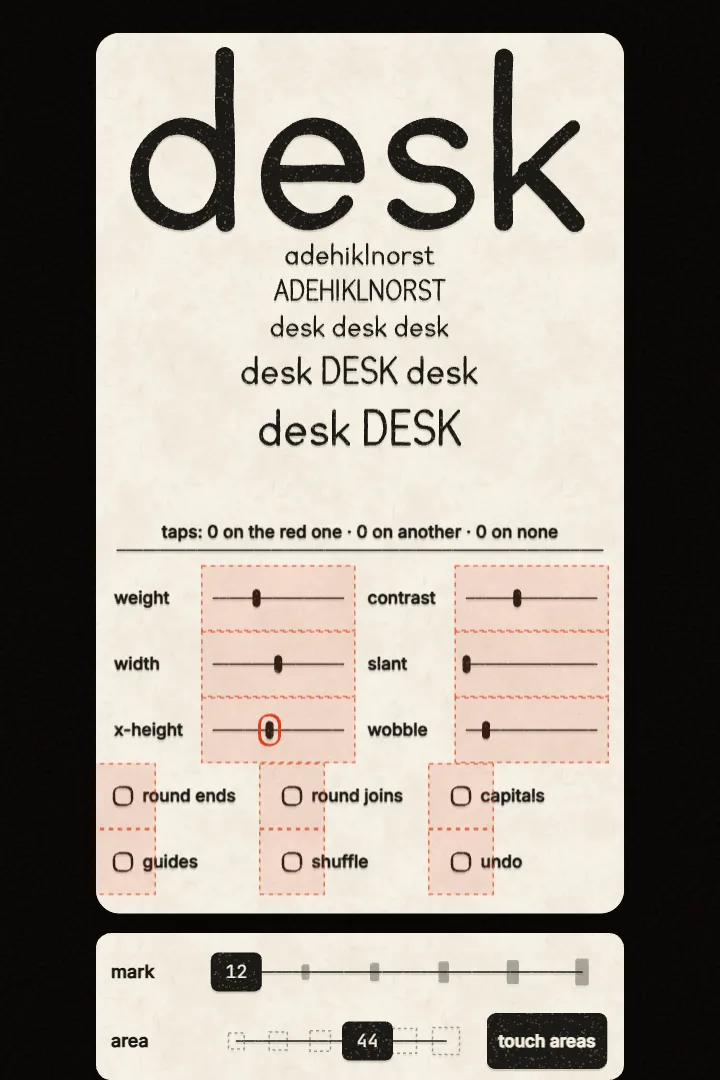
Dense control surfaces: many controls on one phone screen
A type desk on a phone: a word drawn live from stroke centrelines over six faders and six buttons. You pull the drawn mark and the touch area apart and tap at a lit control, move each value beside its control or inside it and watch the panel's height change, paint a fader's track with the stroke it would draw or the smallest gap left in the letters, and give sliding and pressing controls grip ridges and bevels; after each idea the whole desk is rebuilt with every layer as you left it.
-
 Interaction design / touch input
Fine control by touch: how a drag becomes a value
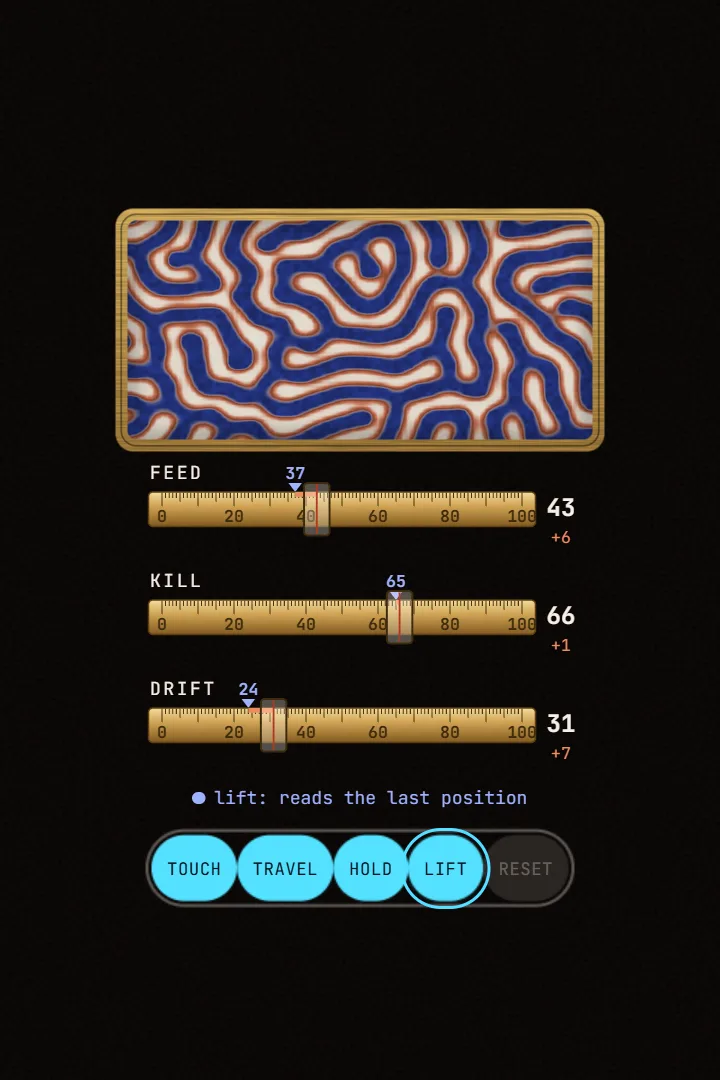
A tray of indigo and rust inks forms spots only when three 240 px brass faders land on exact feed, kill and drift values. You switch what the first touch does, set how far the finger travels per step, add values that hold the thumb, and choose what is read as the finger lifts, then tune the whole strip with every layer you set.
-
 Interaction design / game feel
Movement feel: what a key press does to speed
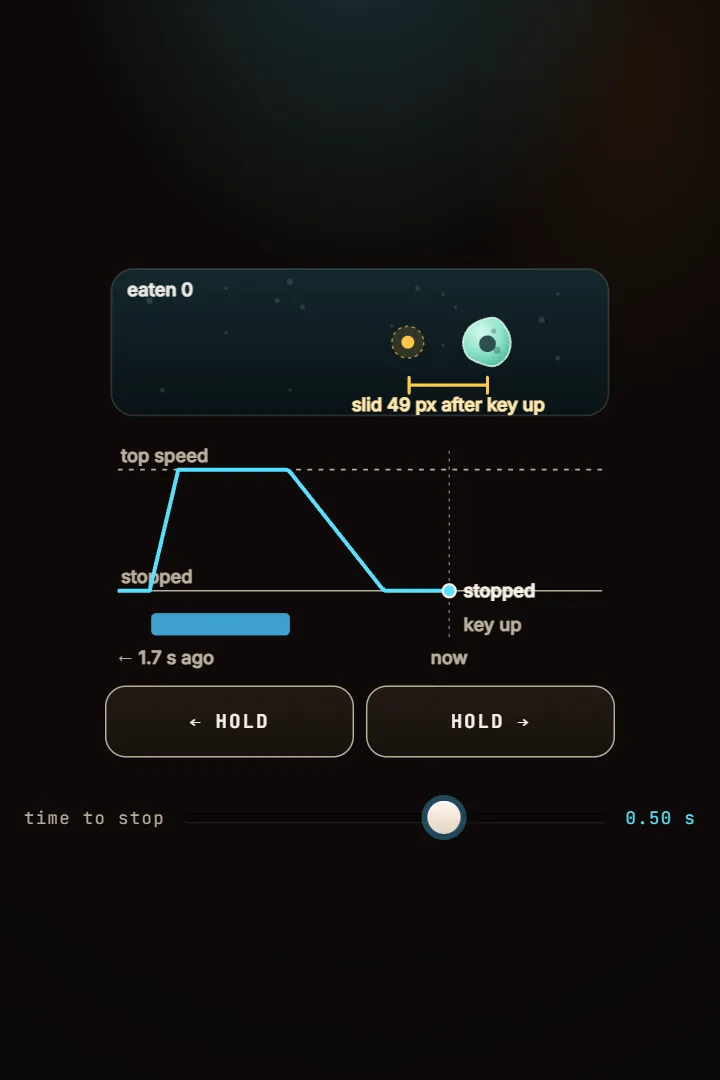
Why a character feels heavy, slippery or twitchy, steered by hand: a cell from Sporeling, a made-up slime-mould colony game, moves along a dish over a live chart of its speed and of the key you hold. You lengthen its time to top speed until a tenth-of-a-second tap becomes a small step, lengthen its time to stop until it slides past the food it was let go on, give reversing its own harder brake and watch the wrong-way drift shrink, swap 0.2 s of lag for a 0.4 s start that covers the same ground, and match each named feel to the part of the line that causes it.
-
 Interaction design / mobile ergonomics
Thumb reach: where touches land on a phone
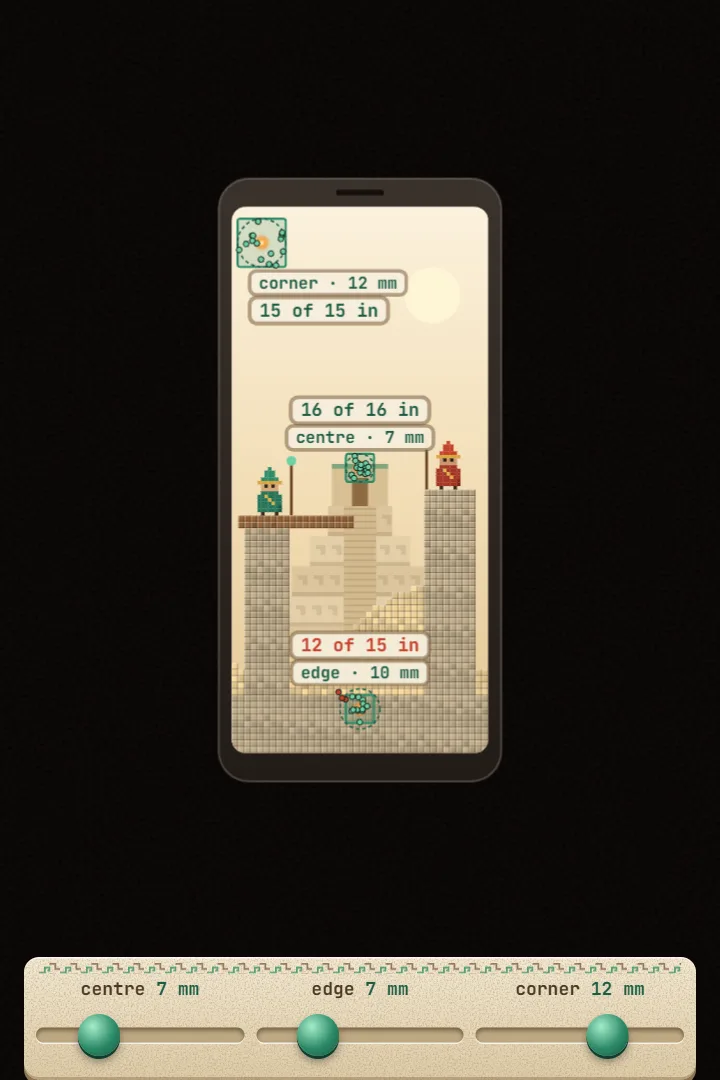
A wizard duel in falling sand on a phone held upright: tap water, wood, acid or lava, pull the cast handle, and the grains answer. You size the touch targets for the centre, the edges and the corners against measured scatter, drag the four spell cards between sockets under four grips, move the cast number out from under the thumb (including a Shift callout), and widen the gap between water and lava while 100 stray taps burn the wizard's own ledge. After each idea the play screen takes what you set, layer on layer.
-
 Painting / painterly rendering
Brush strokes along a direction field
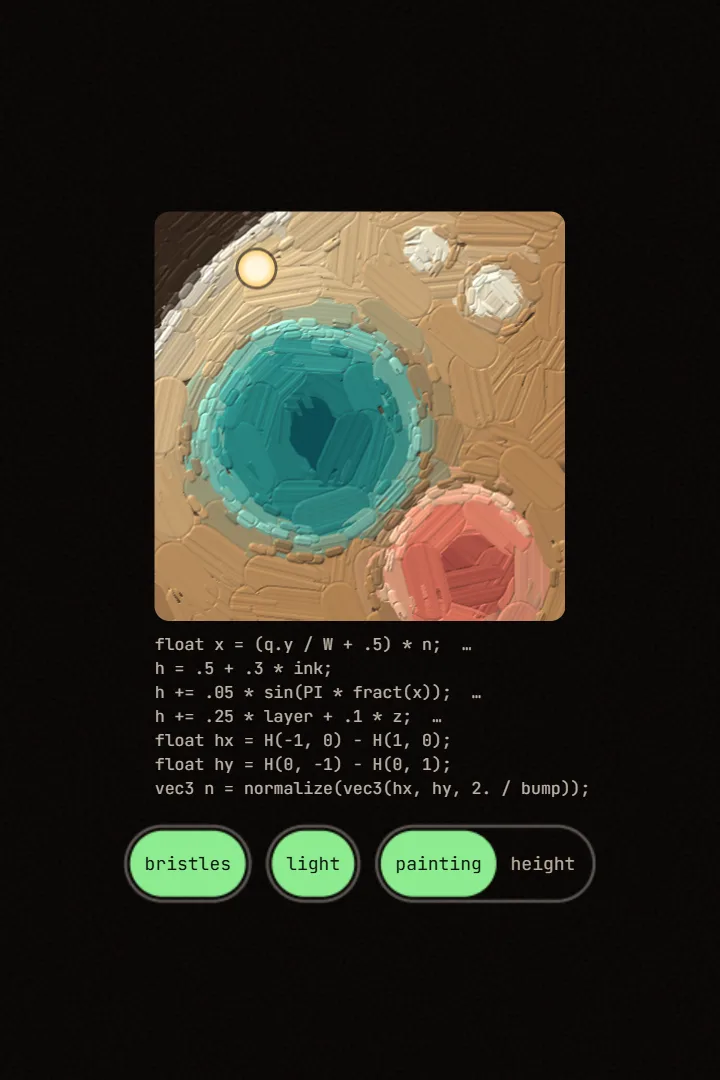
A dish of teal, coral and cream colonies is repainted as separate brush strokes by a fragment shader that searches the 5 x 5 grid cells round each pixel. You drag a ring over the dish to see which of the strokes reaching it lands on top and switch the stacking order, smooth the picture's structure tensor into a direction field and see it as needles, give the colonies and the agar each a field from five, stretch the strokes from round dabs to long sweeps, lay big strokes first and smaller ones only where the paint still differs from the picture, and light bristled, drying strokes as a height field.
-
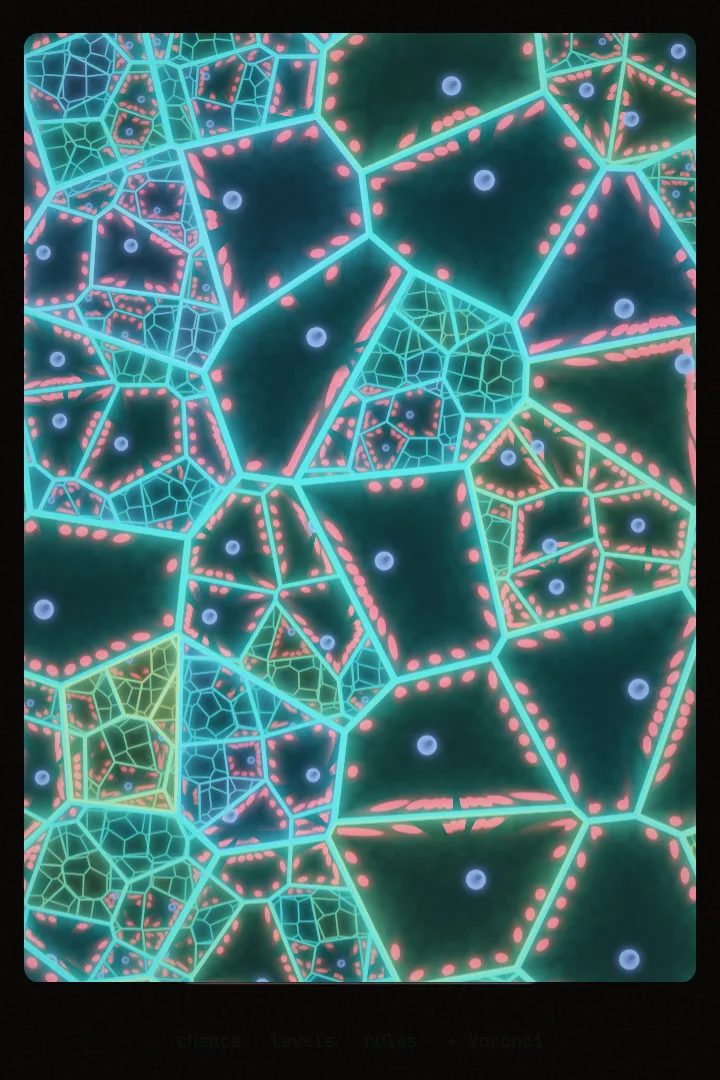 Painting / procedural shaders
Cells inside cells: subdivision in a fragment shader
A dive into glowing plant tissue drawn by one fragment shader per demo. You set the chance that a square splits into four, repeat the split inside each child, change colour, wall and split chance by level, jitter the squares into Voronoi cells that hold smaller ones, swap Truchet colours per size so half-size tiles join the big ones, and dive sixty levels deep while each pixel loops over seven; two build slides draw the tissue from the settings left on each slide.
-
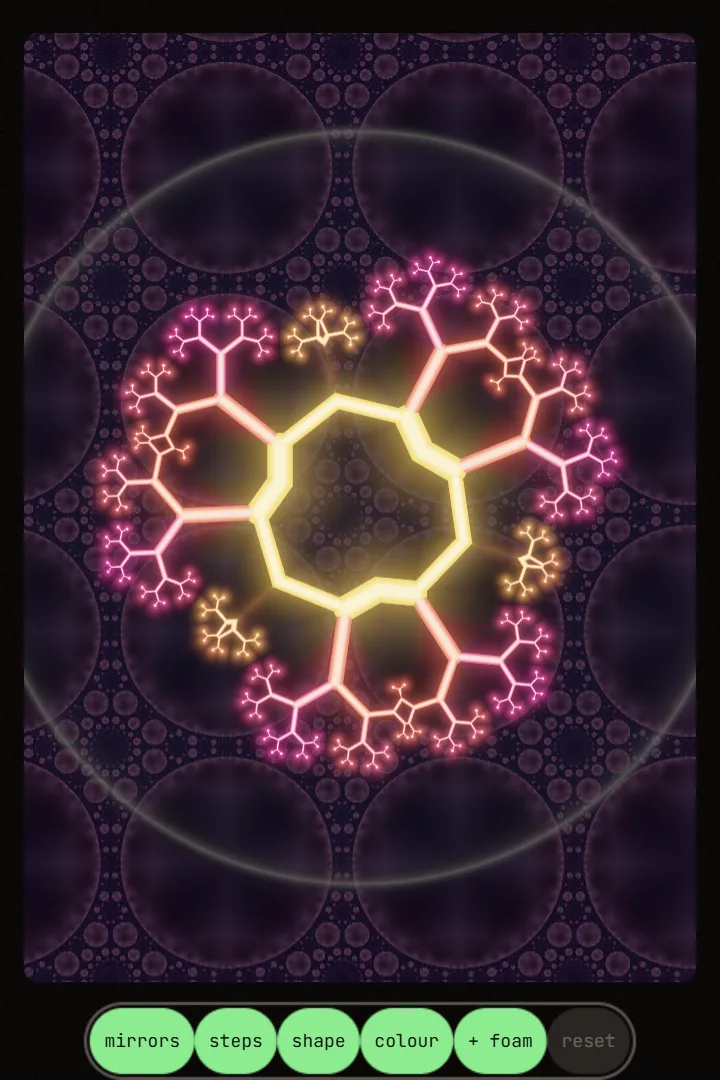 Painting / procedural shaders
Folding space: fractal detail from a short loop
A dark-field petri dish where every picture is one fragment shader folding each pixel's position before it tests one stalk, cell or wall. You drag where mirrors meet beside an amoeboid cell, add fold-turn-shrink steps until one stalk ends in 64 tip cells, turn, lean and shrink the colony, colour it by the path its pixels took through the folds or how near they passed a point or a line, and invert a tiling into a foam of circles inside circles; build slides layer your settings into one colony over the foam. Then you set steps per pixel against a graph of tip cells and work, and two early exits against running every step.
-
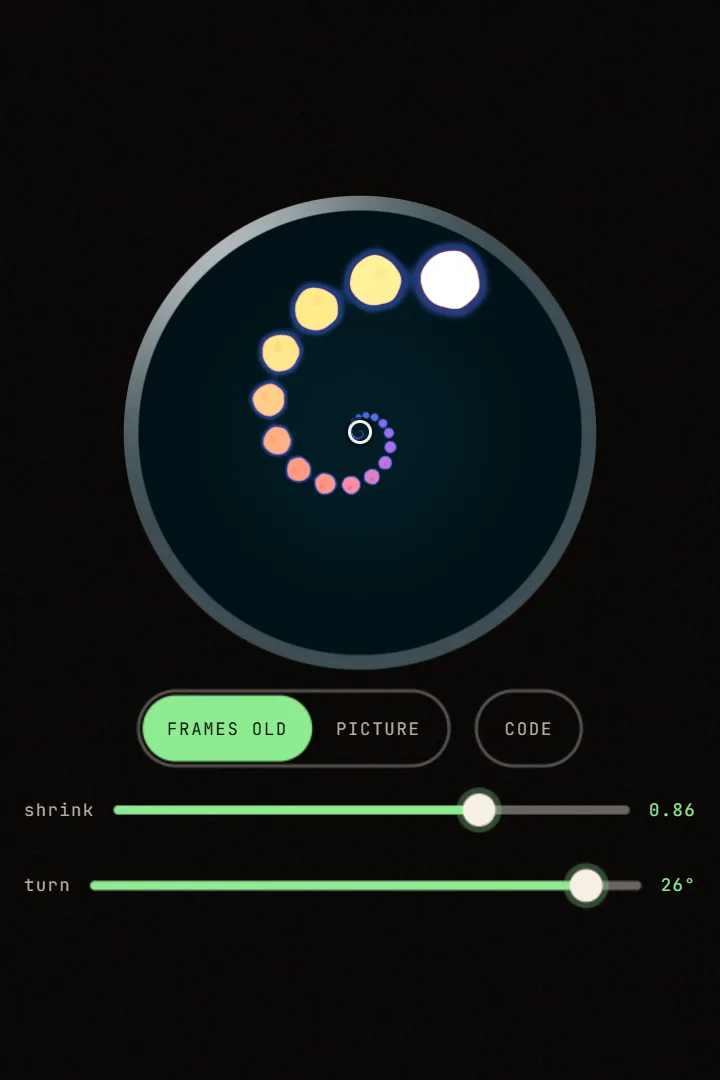 Painting / procedural shaders
Frame feedback: pictures built one pass at a time
A coral cell orbits a dark dish while every frame copies the last one back. You drag the cell and the vanishing point of its spiral, coloured by how many frames old each ring is, switch two or three shrunk copies between a tree, a Sierpinski triangle and a Barnsley fern, scrub that build frame by frame against its texture reads, push gain and blur until the spiral fades, mists or burns white, watch an 8-bit fade stall and leave trails that never clear, grow stripes, spots or both out of the cell by blurring then sharpening, and step the spiral three ways at a low frame rate. After each of the last four, one loop in the dish layers every idea so far at the settings left on its slide.
-
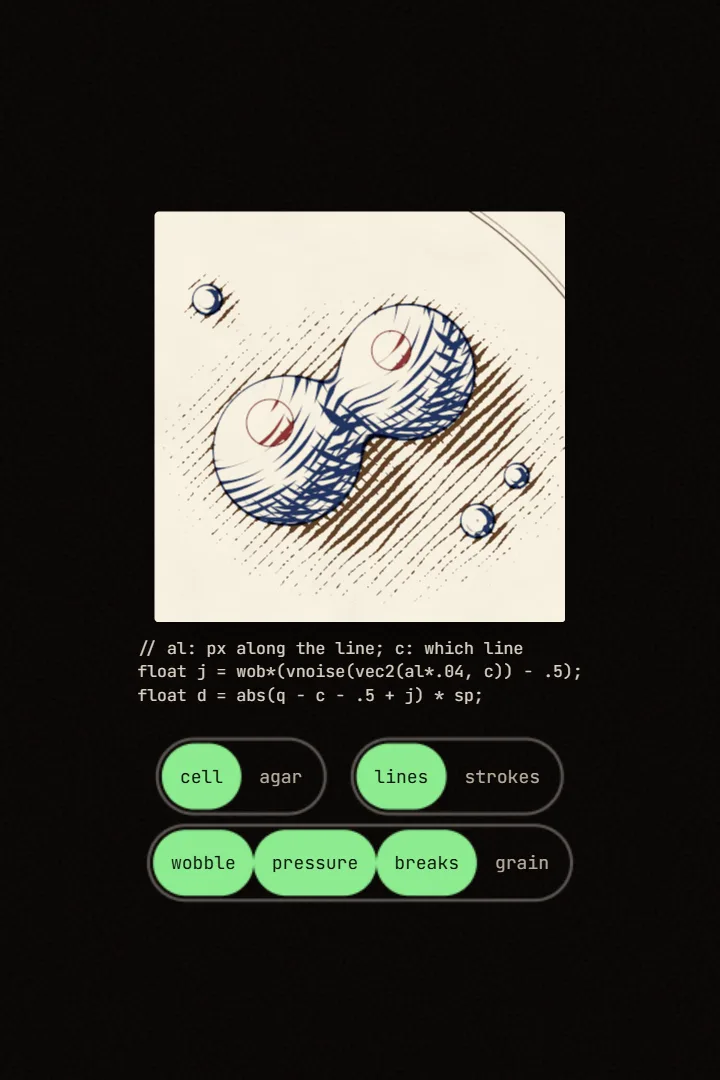 Painting / real-time shaders
Hatching: shading with drawn lines in a shader
A Sporeling cell halfway through dividing, drawn by one fragment shader in indigo, madder and sepia ink on cream paper. You drag a divider between its grey shading and the lines cut from it, as thicker lines or as more lines; watch new lines fade in, grow in or come as a fresh set each step as the light swings; cross a second and third layer over the shadows, one after another or all together; give the cell, the spores and the agar each their own line direction (across the page, over the height, around the edge); zoom in on the waist until new lines appear between the old ones; and add wobble, pressure, breaks and paper grain part by part, with a view that colours each stroke.
-
 Painting / real-time shaders
Painted texture in motion: screen, surface and in between
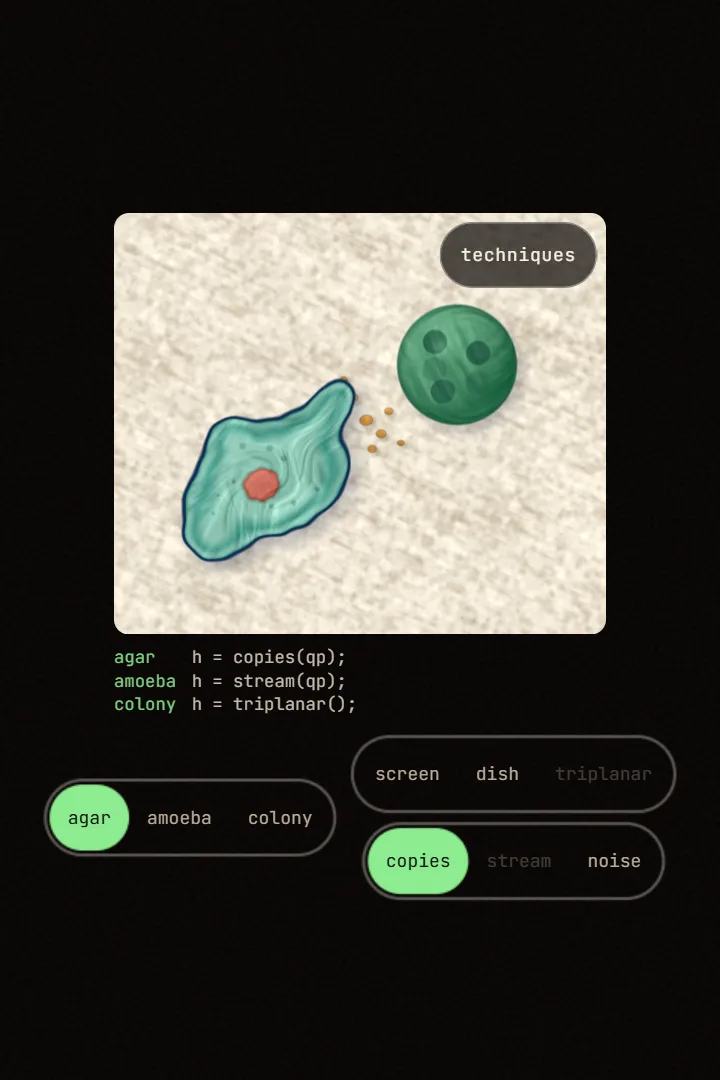
A gouache-painted dish with a streaming amoeba and a rolling colony under a camera that drifts and zooms. You choose for each part where its brush texture is read: from the screen, the dish, the cell or a 3D ball; through copies twice as fine that fade in as it zooms, mixed plainly or with their contrast kept; carried by the cytoplasm stream in two copies half a cycle apart; or rebuilt every frame from fresh noise mixed into last frame's grain. The last slide lets agar, amoeba and colony each run a different one at once.
-
 Drawing / pixel art
Tiny sprites: every pixel is a shape
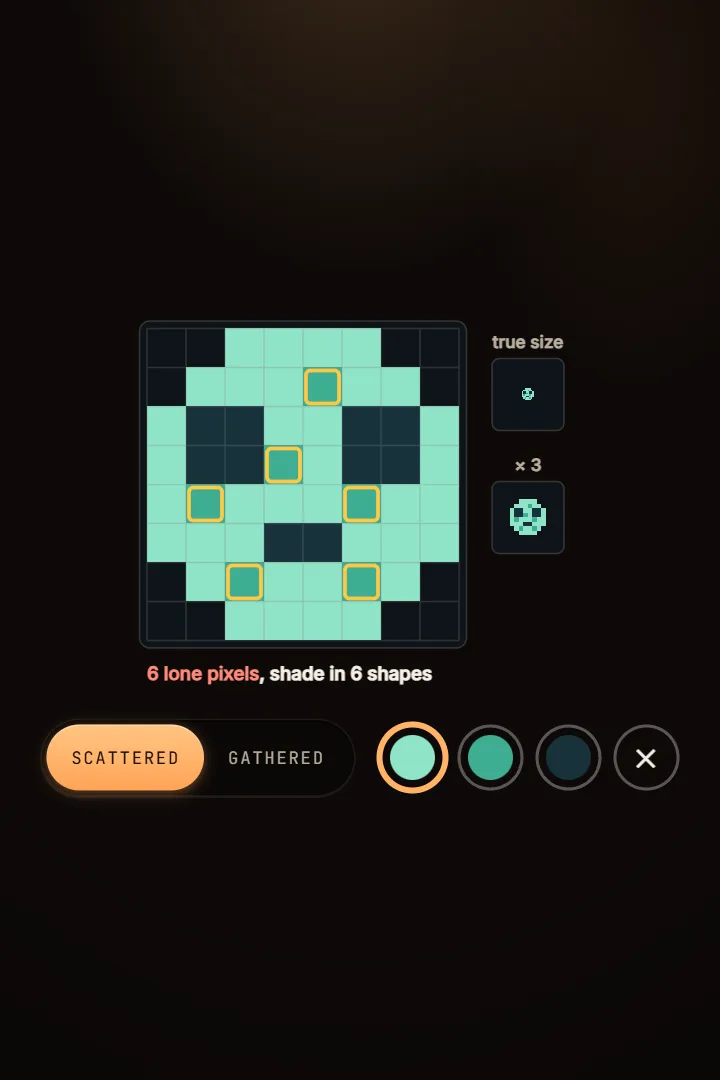
An 8 × 8 microbe from Sporeling, drawn pixel by pixel beside the same sprite at true size. You slide its eyes together until one empty pixel is all that keeps them two shapes, add and widen eyes against a ruler that spends the row's eight pixels on parts, gaps and edges, widen a mouth that cannot sit in the middle of an even grid, fade the ground from dark to pale and pay two pixels for the outline that saves the sprite, and repaint six scattered shade pixels into one shadow.
-
 Painting / procedural shaders
Domain warping: bending where a shape is looked up
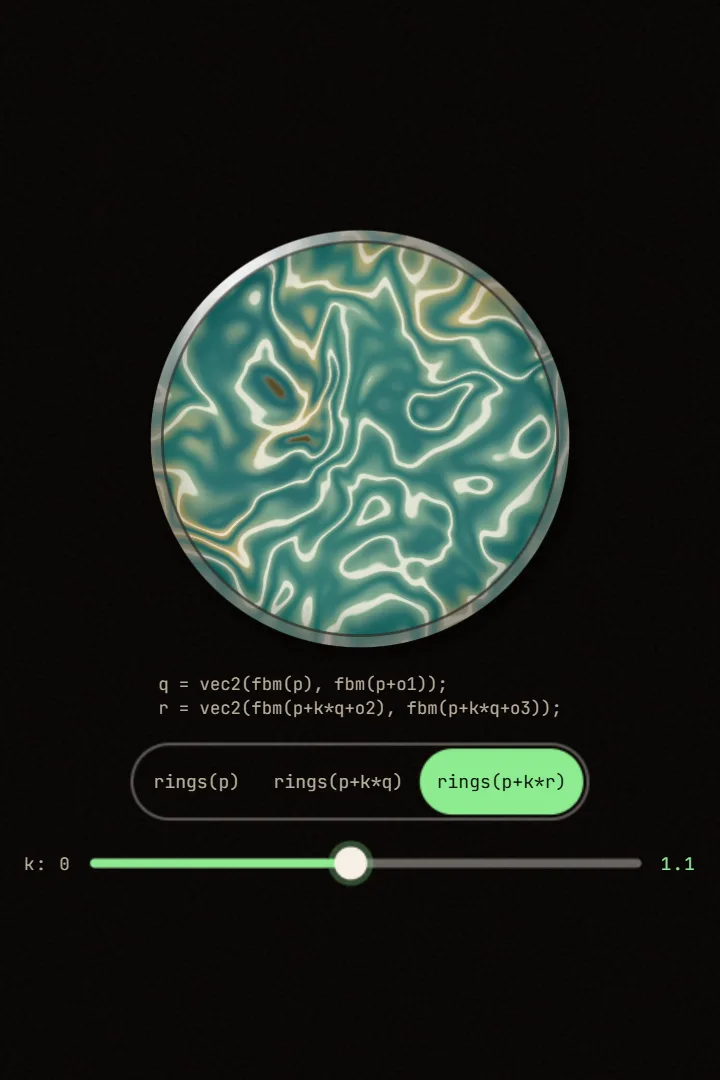
A petri dish drawn by one fragment shader: a ringed mould colony, small bacterial colonies from a texture, a glass rim. You add the same noise to its colour and then to its position, see the warp as an arrow at each point and push it until the picture folds, add octaves until the new bends fall under three pixels, warp the warp until a plate-covering mould's growth rings flow like marble, and animate the warp in place against sliding it across the dish.
-
 Painting / painterly rendering
The Kuwahara filter: painting a render
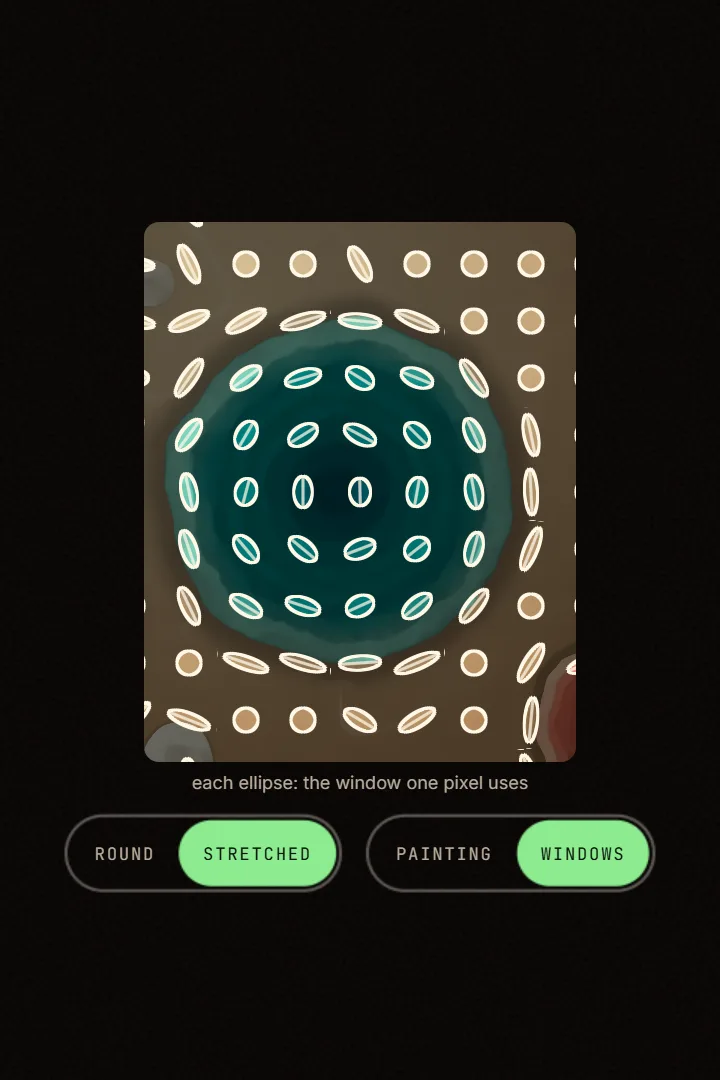
A dish of teal, coral and cream colonies, rendered in a fragment shader and painted by the Kuwahara filter. You drag a line between the render and its painting; move one pixel across a colony's rim and watch the window's four quarters, their averages and spreads, pick its colour; wipe a box blur against the filter on one window; grow the radius; swap square quarters for eight soft sectors; stretch each window along the edges; and see the whole dish painted with the settings left on each slide.
-
 Painting / real-time shaders
Paper grain: how pastel and chalk are shaded
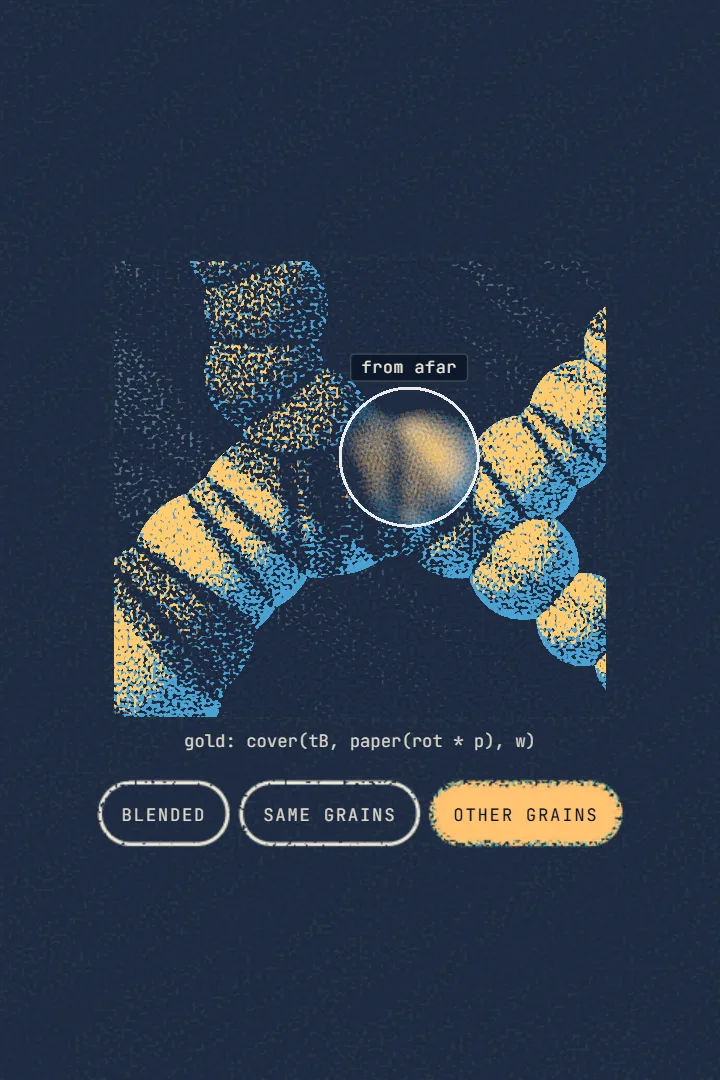
A Sporeling colony drawn in pastel on dark blue paper, every pixel by a fragment shader that compares the shading, broken into broad dragged strokes, against a paper height map. You press the stick from a light scumble to near-solid colour and watch a magnified stretch of one row, seen from the side, take pigment on its peaks and then in its valleys. You widen the edge from hard chalk to a soft smudge, swap the height map between pixel static, fine tooth, cold-press and laid paper, lay a gold over blue on the same grains or on other grains and drag a lens that blurs them as distance does, and pin the background's grain and the cells' grain separately to the screen, the dish or each cell while the camera pans and one cell grows.
-
 Painting / real-time shaders
Watercolour washes: pigment density in a shader
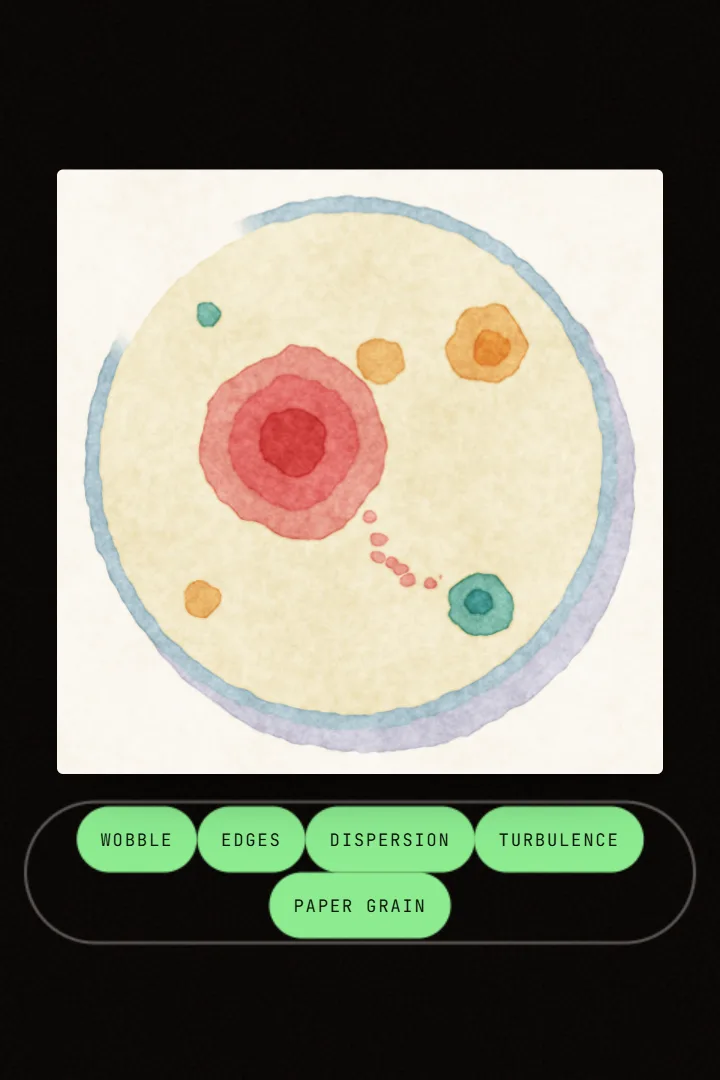
The real-time watercolour recipe of Bousseau et al. (2006), run as live fragment shaders on a Petri dish of colonies painted in flat glazes. You switch each effect on alone and see the density map it makes: the pigment rule that deepens instead of greying, edge darkening from the colour gradient, edges wobbled by the paper's slope, and turbulence, dispersion and paper-grain layers. Then you stack them into a wash.
-
 Evolutionary ecology / game design
When to leave: the marginal value theorem
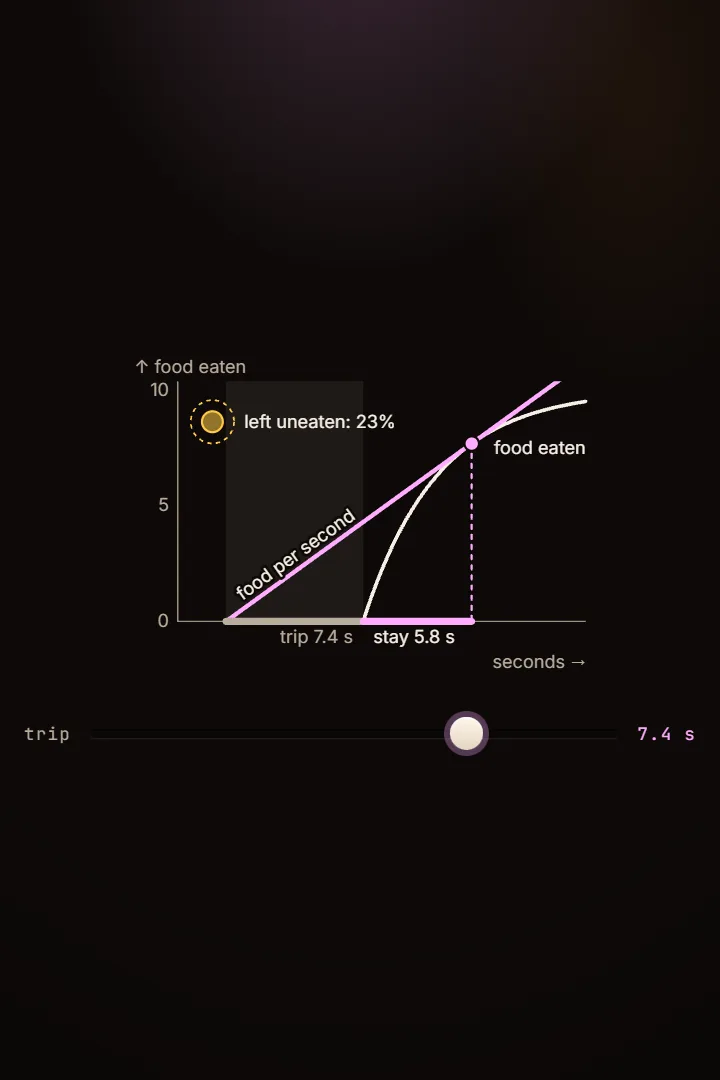
A Sporeling cell grazes patches of food that run out as it eats. You slide a patch from refilling to running out and watch each second's step of food shrink, set how long the cell stays and draw a curve of food per second, trip included, that peaks at a middle-length stay, move a line from the start of the trip until it only touches the food-eaten curve, lengthen the trip and watch the best stay grow, set one leaving level for a rich and a poor patch until it meets the dish's average, and take away the running out or the trip to see the best stay slide to one end of the graph.
-
 Drawing / creature design
Offset curves: why mirrored bodies look stiff
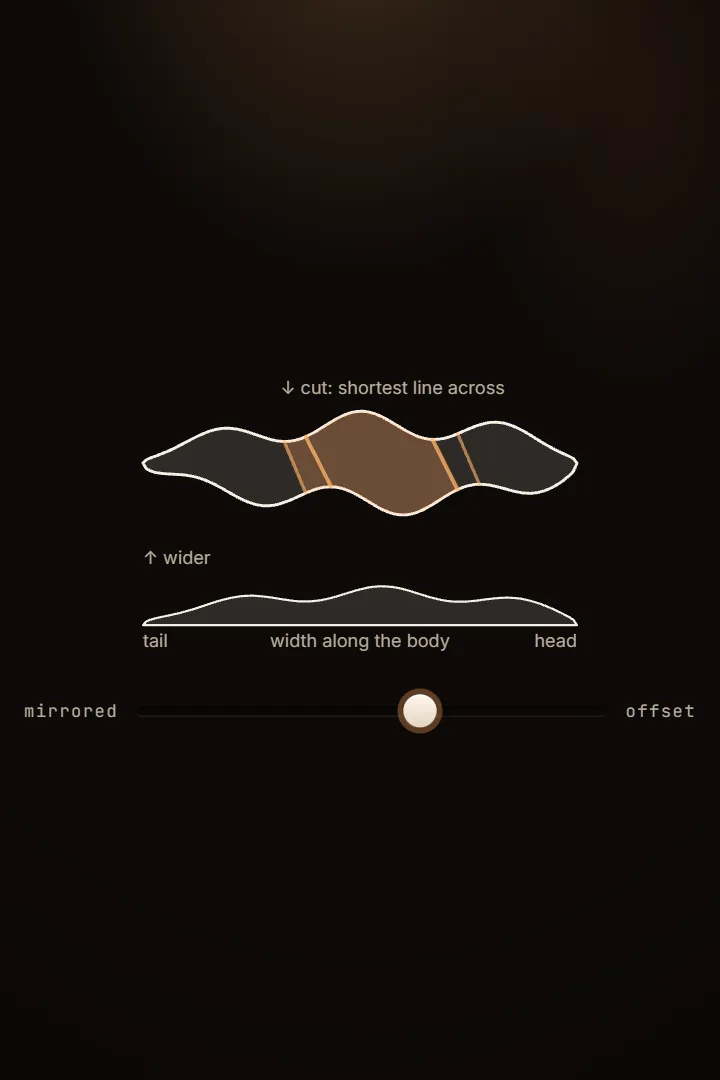
A Sporeling crawler drawn as an outline, a spine with a distance to each side. You slide its lower side along until the dips stop facing each other and watch the cuts across it lengthen and its three segments merge, see the line midway between the sides go from straight to bending as its bulges travel, bend a feeding arm as a pipe and as flesh, and slant the cross-sections of a body generator so that every crawler it makes comes out offset.
-
 Biology / creature design
Scaling: why bigger is a different shape
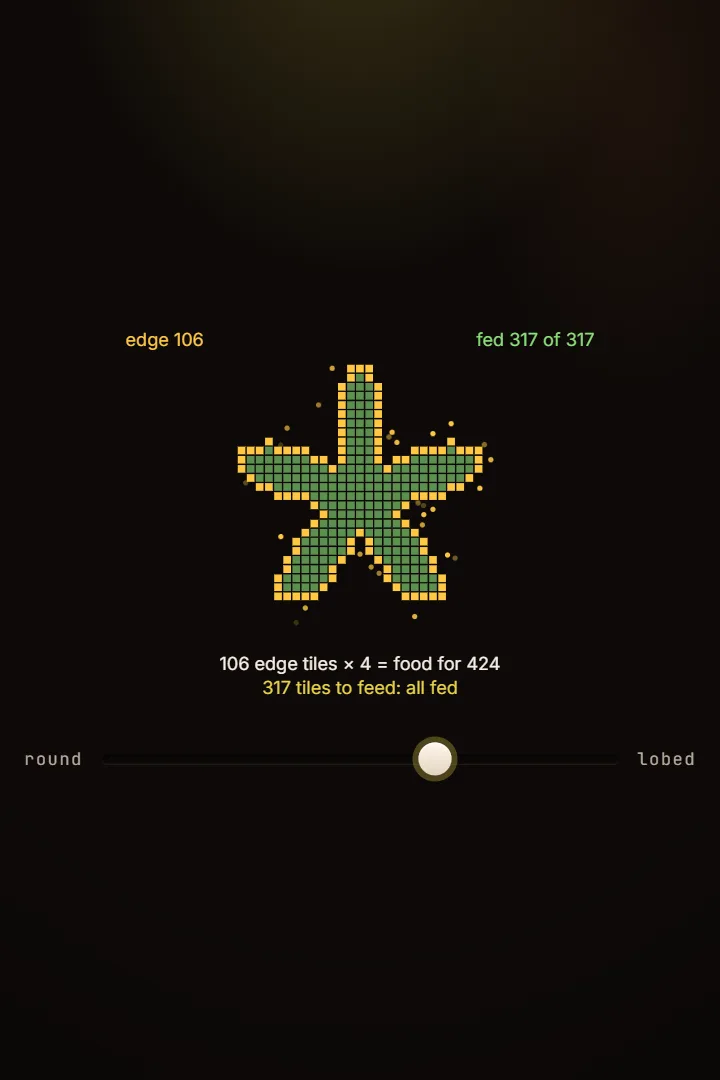
A Sporeling cell drawn as tiles feeds through its edge. You widen it until its middle starves, lengthen a block of cubes and count its surface against its volume, push the same tiles out into lobes until every one is fed, scale a fruiting body up until its stalk gives way and thicken the stalk until it stands, and slow one of two identical drawings until it looks a hundred times taller.
-
 Sculpture / creature design
Big, medium, small: forms that read
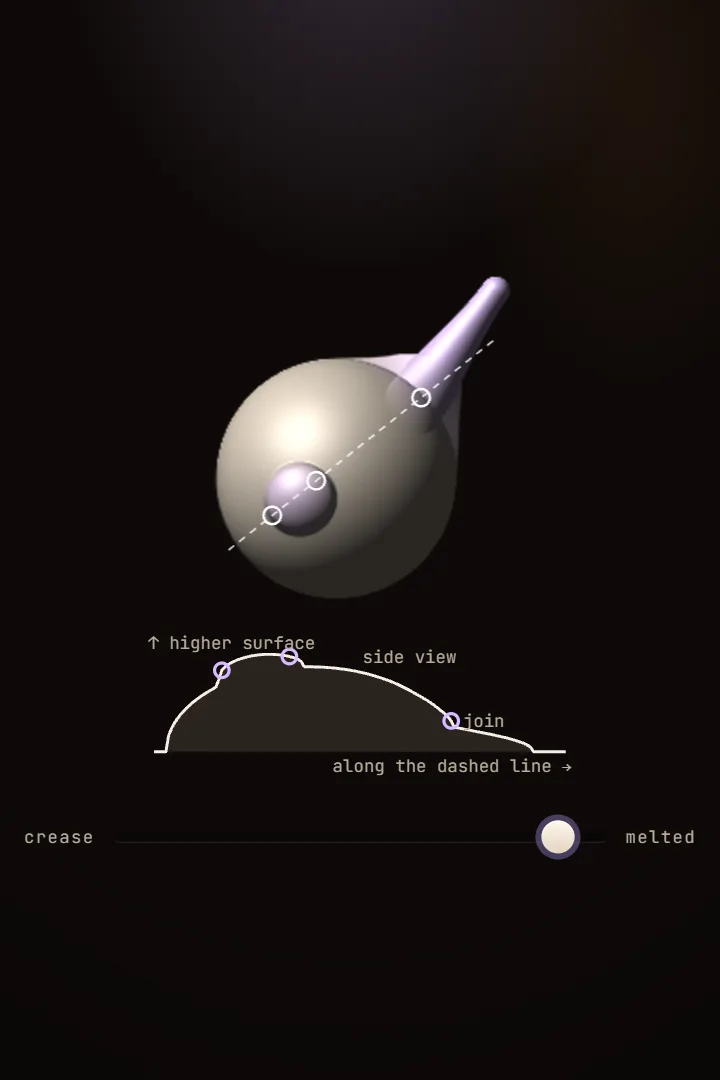
Sporeling's microbes, sculpted live in clay. You step back from three pairs of cells, each differing at one level, and watch the small forms blur away first and the medium ones next as the blur widens, grow a cell's lobes until they match its body and it turns into a clump, blend a feeding arm's join from a glued-on crease to a melted ramp while its side profile shows the kink, and gather the same 24 bumps at the mouth to leave the tail quiet.
-
 Interaction design / procedural generation
The ladder of abstraction: seeing what a generator does
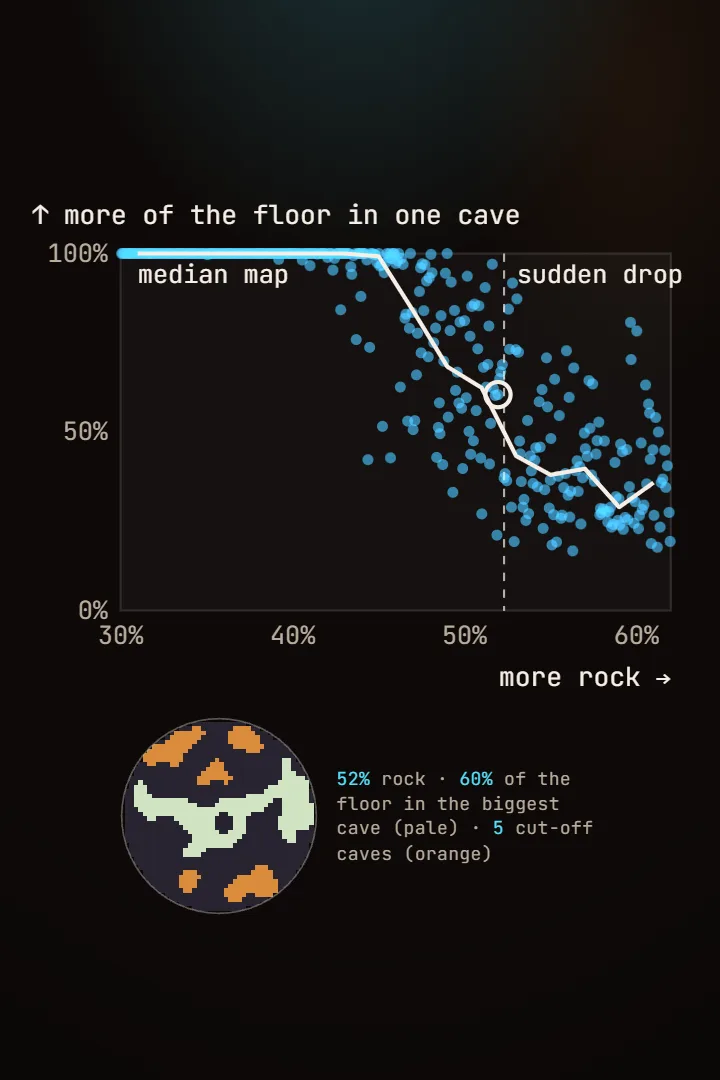
Sporeling's map generator scatters rock over open floor and smooths it into caves. You move its rock setting on one map that gets a new seed every run and find a new seed moves the caves as much as the setting does, then fix the seed across a grid of maps to see the setting alone. You run hundreds of maps as dots until a sudden drop appears, tap a dot to step back down to its map and see the seed decide near the drop, and drag across a grid of rock density and smoothing passes to watch smoothing move the drop.
-
 Information design / graph drawing
Flow diagrams: lines the eye can follow
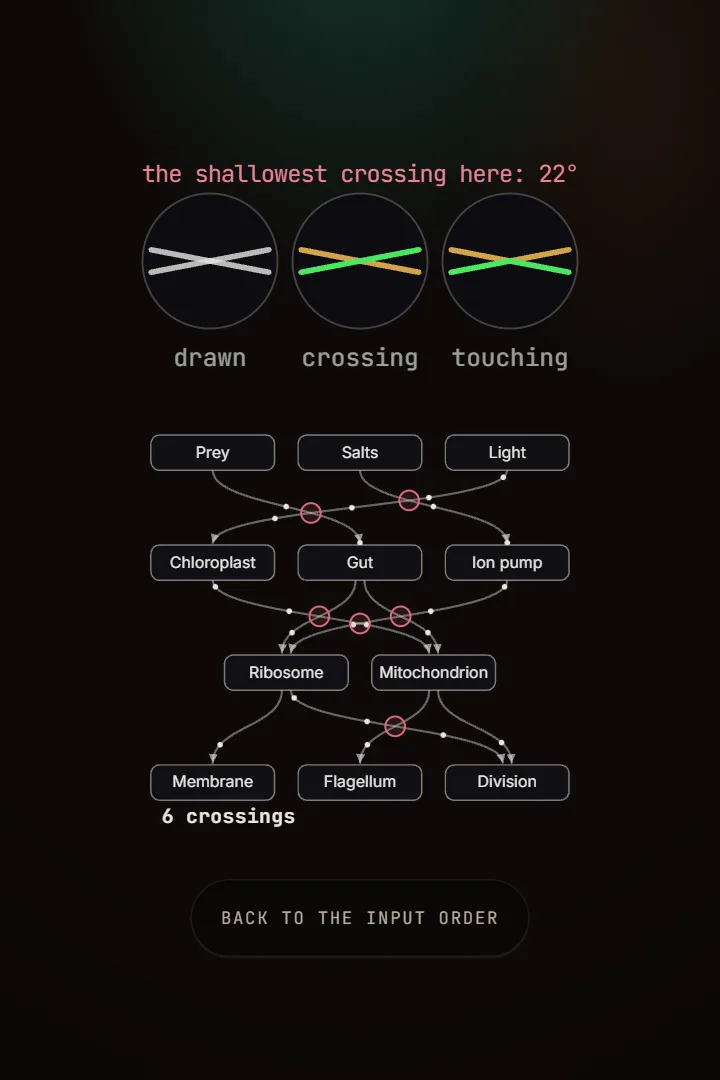
A made-up cell's supply chart, from light and prey through its organelles to the parts that use what they make, laid out the way layered-drawing tools do it. You tap a part to trace what it needs and feeds, slide the parts from where they sit in the cell into columns in flow order and watch backward arrows vanish, drag parts to untangle crossings while a close-up shows why shallow ones mislead, run the barycentre sort that takes six crossings to none in two passes, snap parts level to straighten stepped lines, and route mitochondria through one ATP pool instead of a line per pair.
-
 Vision science / game legibility
Pop-out: what the eye finds before it looks
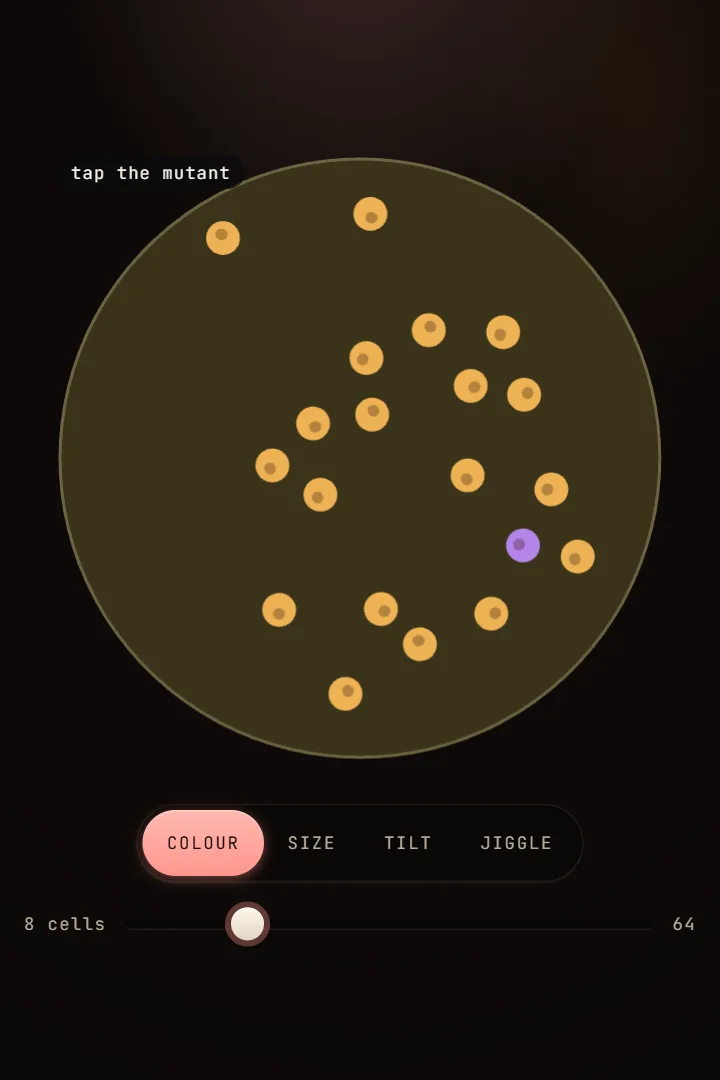
In a Sporeling dish of drifting slime-mould cells you hunt for the one mutant, timed. You switch which single feature sets it apart and add cells to see it still jump out, then hide it in a combination of violet and spiky and feel the search slow. You plot find times against the number of cells, watch per-feature maps and a hopping spotlight show why, swap a tail from present to absent, close the hue gap between the mutant and its neighbours, and redraw the colony's hunger so the mutant gets a map to itself.
-
 Collective behaviour / simulation design
Stigmergy: roads nobody planned
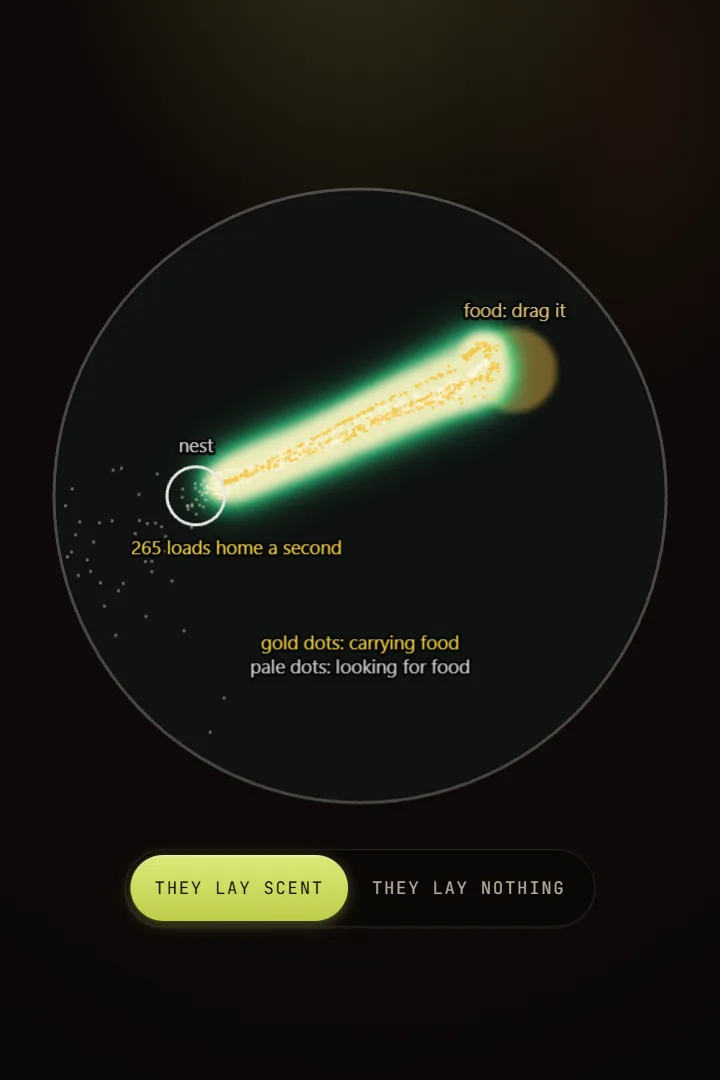
Walkers on a dish that only sense three spots of scent ahead of them build a road network between them. You paint scent and watch one walker follow it, slide a dish of walkers from ignoring scent to following it and watch roads form out of an even spread of scent, stretch one road of an ant bridge and watch the colony settle on the shorter one, then change how fast scent fades and watch a colony stuck on an old road take a new shortcut. Last you run a forager rule adapted from Synapse's foragers: drag the food and watch the road follow it, or stop walkers carrying food from laying scent and watch the deliveries fall.
-
 Signal processing / real-time graphics
Sampling: when a smooth field looks low-def
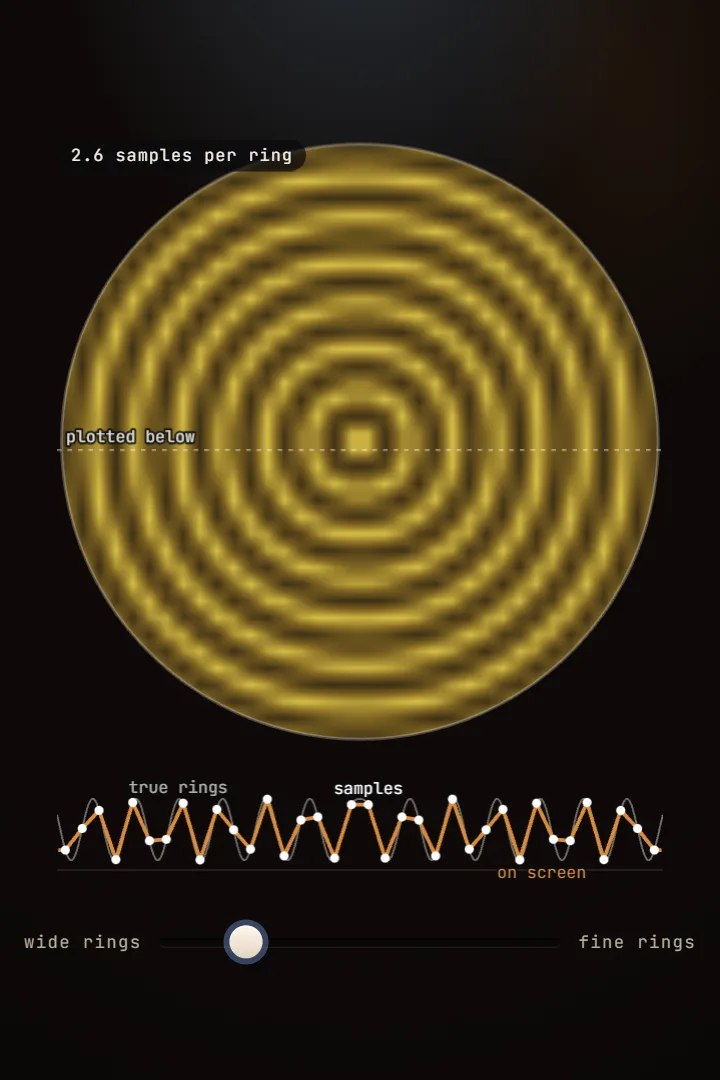
A Sporeling dish's scent field (strongest at the slime mould, along its veins and at the oat flakes) is sampled on a grid before it is drawn. You drag the mould and change the grid size to watch thin veins break up, then switch between nearest, bilinear and bicubic filling on the same twelve samples a side. You make rings of scent finer than two samples per ring until the samples trace a false wave, average several samples per square to fade the false rings, and cut the glow down to a few levels to watch bands crawl until dithering trades them for grain.
-
 Physics / motion design
Springs: motion without a duration
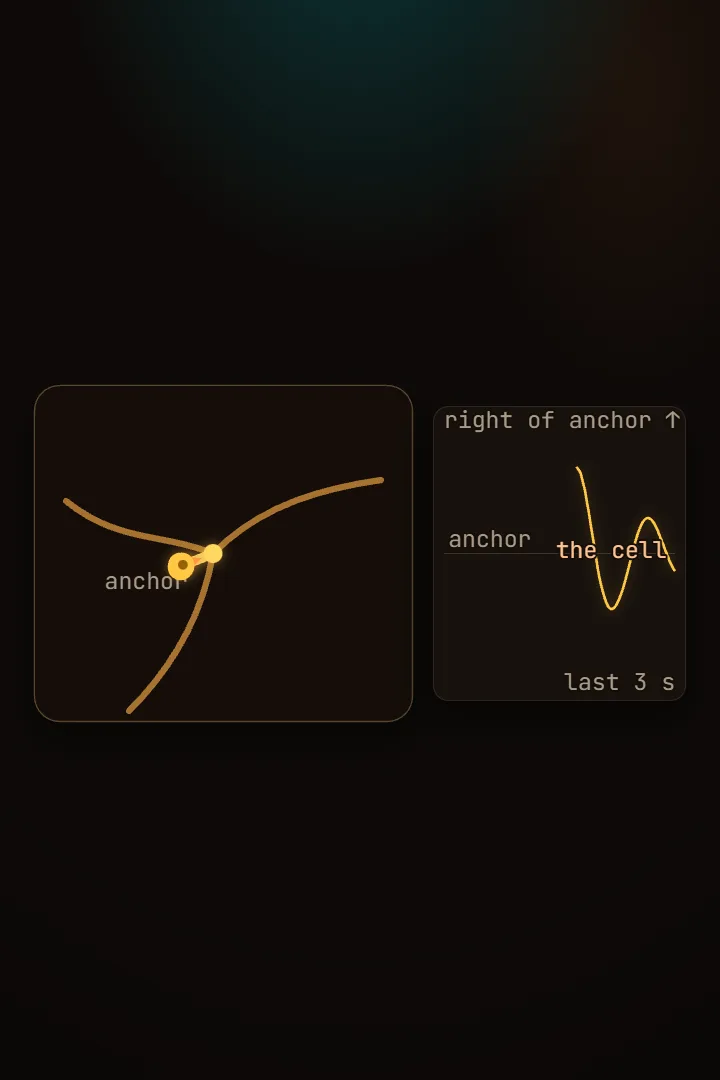
Why spring physics makes interface motion feel alive, played out in Sporeling, a made-up slime-mould colony game. You switch a crawling cell's easing curve and read its speed from its position drawn every 0.13 s, pluck a tethered cell to feel Hooke's law, dial a trait card's damping ratio against its overshoot and settling time, move an oat flake mid-chase to see a tween stall while a spring keeps its speed, and fling the evolve drawer so the spring inherits your finger's velocity.
-
 Evolutionary ecology / game balance
Trade-offs: why no strain wins everywhere
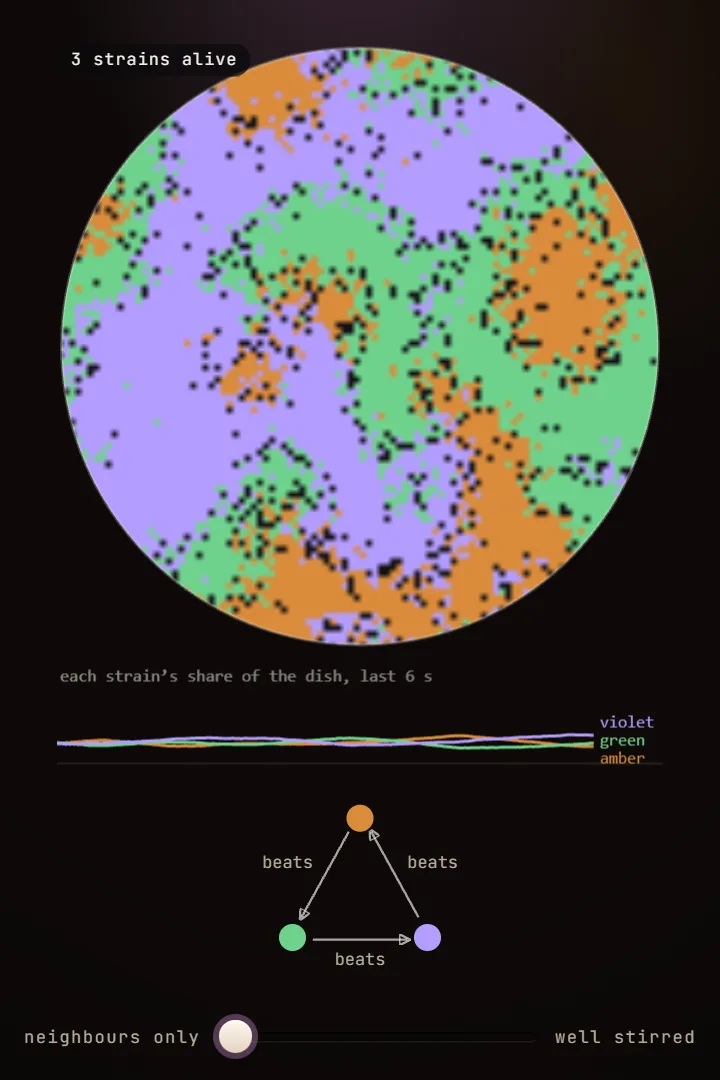
A slime-mould colony in a made-up colony game splits one food budget between far-reaching veins and toxin-proof walls. You slide the split and watch toxin cut thin-walled veins back, drag the colony as one point on a graph of spread and hardiness, then drag rival strains until one is beaten at both and greys out. You mix a dish of open agar and toxin to watch the winner move along the Pareto front, and turn the returns on food from diminishing to accelerating until the front bulges and generalists win, or sags and only specialists do. Last, you stir a dish of three strains that beat each other in a rock-paper-scissors loop and watch two die out.
-
 Visual / UI design
Hierarchy, depth and contrast in UI
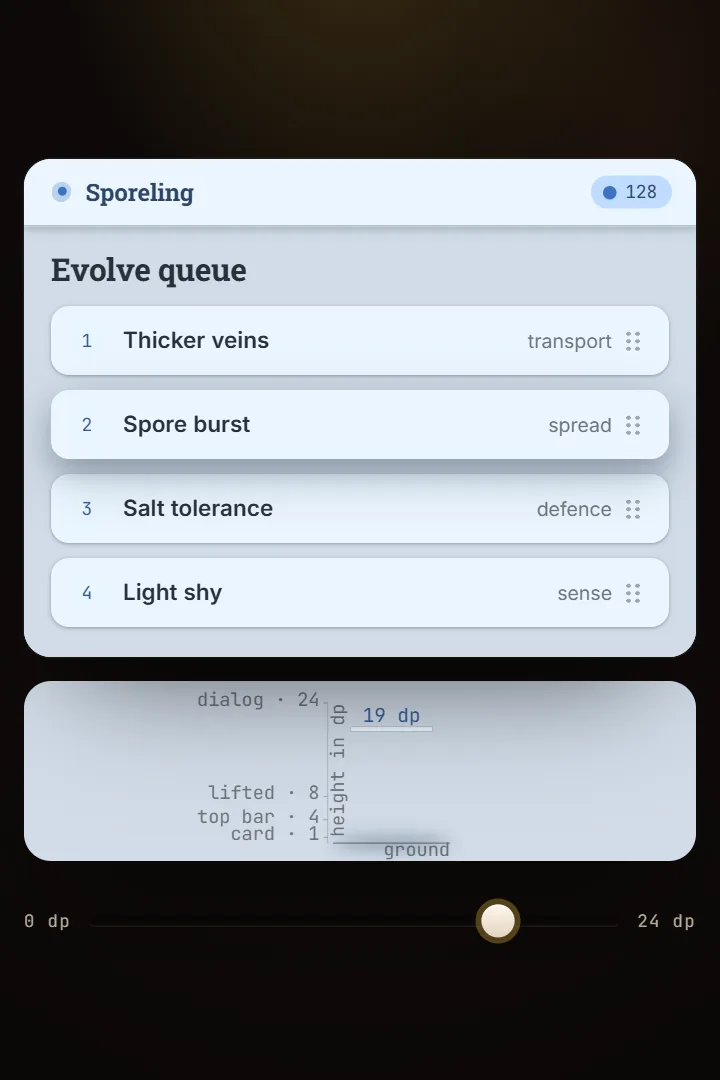
Screens from Sporeling, a made-up slime-mould colony game (its dish select, strain editor and colony log), start with every element at one weight. You make the changes that give them structure: fade the other columns, lift cards with shadow, group with space instead of boxes, give each colour a range of shades, tint the greys, and use one accent.
-
 Visual / UI design
Refinement in UI
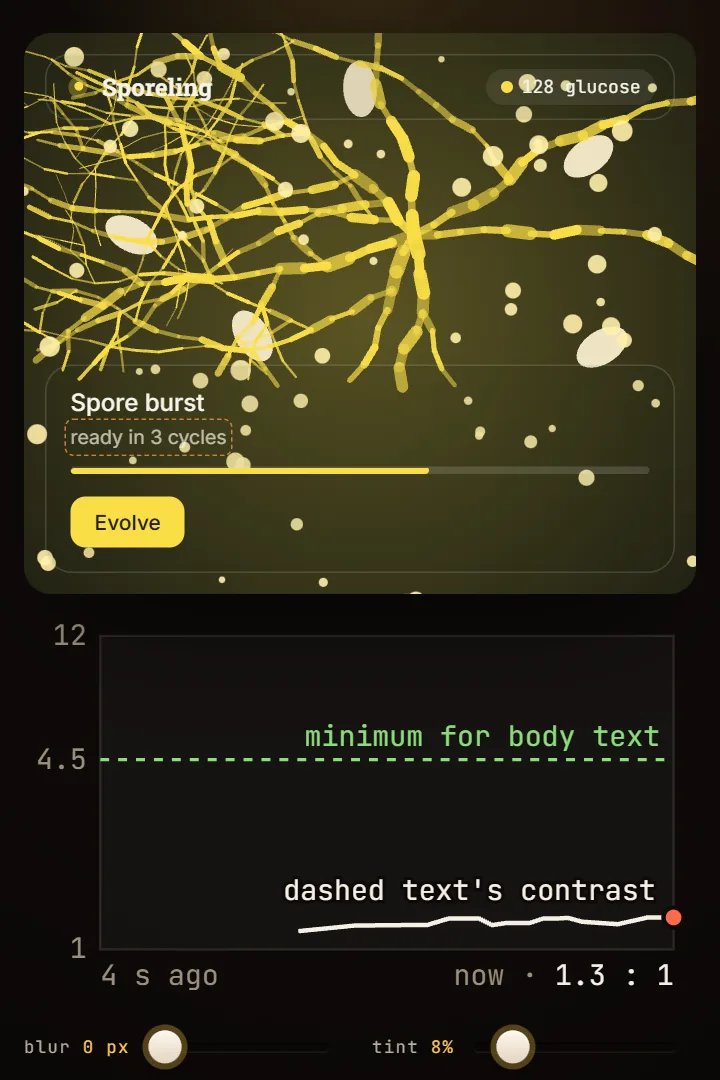
Five small details that make a screen feel crafted, each one a control on screens from Sporeling, a made-up slime-mould colony game. You thin a trait panel's borders and icons to the weight of its text, nest a level card's corners on a shared centre, slide a play triangle until a beam carrying its mass levels under the button's centre, grow a heading and watch its letter gaps grow with it until it tightens, and blur the HUD's glass while a live trace shows its text's contrast steadying over the spores drifting behind it.
-
 Painting / colour theory
Value and chroma
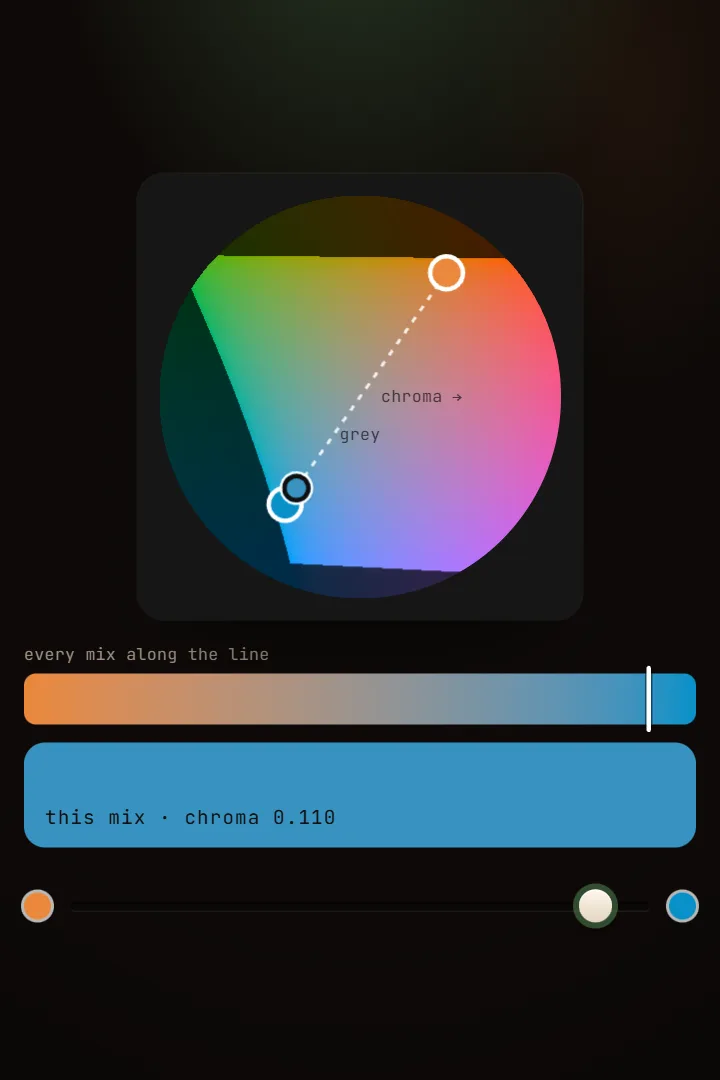
Munsell split colour into hue, value and chroma. In a Sporeling dish, a slime mould reaching across agar for oat flakes, you pull murky colour apart into its two causes: values crowded at one lightness, and strong chroma everywhere. Then you fix it the painters' way: group values, keep strong chroma to one place, mix inside a limited gamut, and judge lightness perceptually.