How acidic or alkaline the ground under a cell is, on the 0-14 scale; a cell is comfortable inside the band its tolerance gene names and drains cytosol outside it, but pH never kills outright.
pH is how acidic or alkaline the ground under a cell is, one of the two conditions engraved into
the substrate field and read out on the familiar 0-14 scale,
with 7 neutral. Every cell carries a pH tolerance gene that sets the pH it prefers and the safe
range either side of it. Outside that range the cell leaks
cytosol at a rate that rises the further out it stands.
pH never kills outright. There is no lethal threshold anywhere on the scale, unlike
temperature: a cell dies of pH only when the leak empties
it, and that death is reported as acidified where the ground was acid and alkalized where it
was alkaline.
Cytosol drain
Inside the band the ramp charges nothing. Outside it, drain rises with the square of how far
outside, reaching its ceiling 2.8 pH points past the edge at width 1.0. The ramp itself is scaled by
the width multiplier. Whatever it charges is then scaled by the cell’s cytosol capacity and by its
membrane permeability, so the same bad ground drains a large leaky cell harder than a small tight
one.
A width above 1.0 charges a residual: how far above 1.0, times an authored rate, held as a floor
under the pH damage rather than added to it. The floor is scaled by how far the ground sits
from the optimum as a fraction of the band, so it is nothing at the optimum and full at the band
edge. A width below 1.0 pays nothing extra and buys nothing except a smaller target.
The stress badge on the inspect readout fires further out than the band edge, where the drain reaches
a fixed threshold, so ordinary field noise just past a razor-thin band raises nothing.
Tolerance band
Two numbers on the pH tolerance gene set the band.
Gene value
Range
Optimum
pH 1.4 at the acid end to pH 12.6 at the alkaline end. Nothing evolves past those.
Width multiplier
0.3 (razor-thin) to 2.5 (very wide). 1.0 is the default and the only free setting.
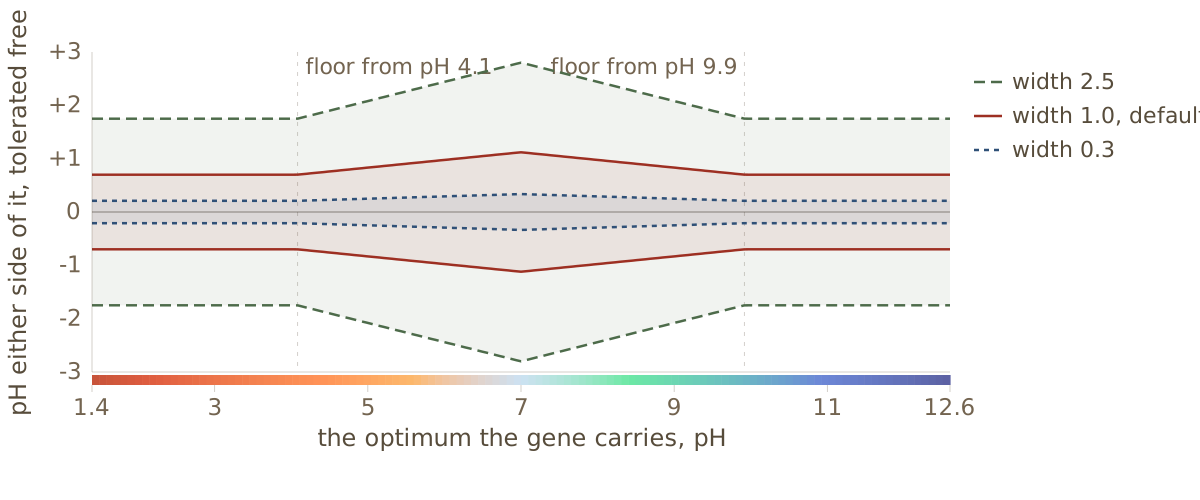
The band reaches about 1.1 pH points either side of a neutral optimum, narrows the further the
optimum sits from neutral, and is floored at 0.7 points so a full specialist still survives the pH
spread inside one generated zone. The width multiplier scales what survives that floor. A lineage drifting toward
an extreme therefore gets a narrower band for the same width setting.
How much ground either side of its own optimum a cell tolerates for free, for every optimum the gene may carry. The band pinches as the optimum leaves neutral, then stops pinching at the floor.
The gene is losable. A cell that loses it behaves as a neutral generalist at width 1.0 and still
takes drain at the extremes.
Optimum drift
The optimum moves on a division where the pH tolerance gene is
picked to mutate, a per-gene roll at a rate authored per dish and multiplied by any mutagen the
culture is under. The daughter’s optimum then takes one step along the axis, weighted toward
whichever side of neutral the local ground is on. The step is not aimed at the ground’s value: a cell
on mildly alkaline ground is pushed further alkaline even if its optimum has already passed the local
pH. The weighting is never a gate, and a step against the gradient stays possible at every strength,
only smaller.
Within roughly 0.7 pH points of neutral. The weighting is skipped and the step is symmetric.
Past that. The weighting scales with distance from neutral.
At pH 1.4 and 12.6. Full strength, where a counter-gradient step is cut to an eighth and a
with-gradient step is multiplied by 1.6.
Extreme ground also raises how large and how often
mutations land, so a dish taken to an extreme drifts a lineage
several times faster than a mildly off-neutral one.
Directed mutation
Double-clicking a cell’s nucleus applies a paid dose. It charges
trophin and reads the ground around that cell. On the pH axis it
forces the width or the optimum, never both:
If the pH spread around the cell is wider than the strain’s own band, no single optimum covers
that ground, and the dose forces the width axis wider on the next division.
Otherwise, if the pH under the cell is more than about 0.7 points off neutral, it forces the
optimum instead.
Either way the forced step closes a fifth to two fifths of the remaining gap: to the local pH for the
optimum, to the 2.5 maximum for the width. Four to eight dosed divisions take a neutral strain to an
extreme.
A band-carrying mutagen compound overrides the ground
entirely. An acid-band compound drives the optimum acid and an alkaline-band one drives it alkaline,
wherever the cell is standing, and its tier sets how far, linearly, with tier IV aiming at the rail.
Sources of ground pH
pH spreads by diffusion through the substrate and is not pulled back toward neutral the way
temperature is pulled back toward ambient. A patch driven acid stays acid until something else drives
it the other way.
Metabolism does not write pH, and nothing fills a pH vacuole. The organelle can still be evolved
and still charges its maintenance drain, but it banks nothing and releases nothing, so building one
costs a cell and changes no ground.
The field is written by:
Death. A corpse stamps the cell’s own preference, pulled 80% of the way from neutral toward its
optimum, at a strength scaling with how far from neutral it stood and with the energy it died
holding. A neutral cell leaves almost nothing.
An endoplasmic reticulum in secretor mode, driving local pH toward an evolvable set-point, at a
strength rising with how many secretors the cell carries.
Digestive enzymes carrying a pH modifier, which shift the field where the cloud bursts, by the
direction and weight that modifier evolved.
Acid and alkaline compounds, the crystals that emit them, and the environment brush, which
blend a patch toward a stated target.
Ecotype
The optimum is quantised into buckets about 1.1 pH points wide, fixed regardless of the cell’s own
width multiplier and centred on the starter’s neutral. That bucket joins the cell’s temperature
bucket, its transmembrane organelles and its flagellum count in one surface signature. Two strains
in the same bucket hash identically and are the same ecotype; a strain that drifts out of it is
not, which is what lets a cell accept a corpse fragment from a stranger and raise a targeted
antibody. It also separates a player strain from a rival
contaminant clade, which is built from the same starter
and differs only on these two axes.
Scrap compounds
A scrapped cell pays out compounds named for the band its pH gene sits in, counted in the cell’s own
tolerance bands rather than in pH points:
Distance from neutral
Band
Within one band
Neutral
Within two bands
Acid or Base
Beyond that
Strong acid or strong base
Width therefore changes the answer: a razor-thin specialist and a wide generalist at the same optimum
do not scrap the same compound. The band picks the compound’s root word, and a Neutral band gets the
bare roster word with no root at all. It does not set the mass paid, and a strain carrying none of
the genes the roster points at yields nothing at any optimum.
Ground colour
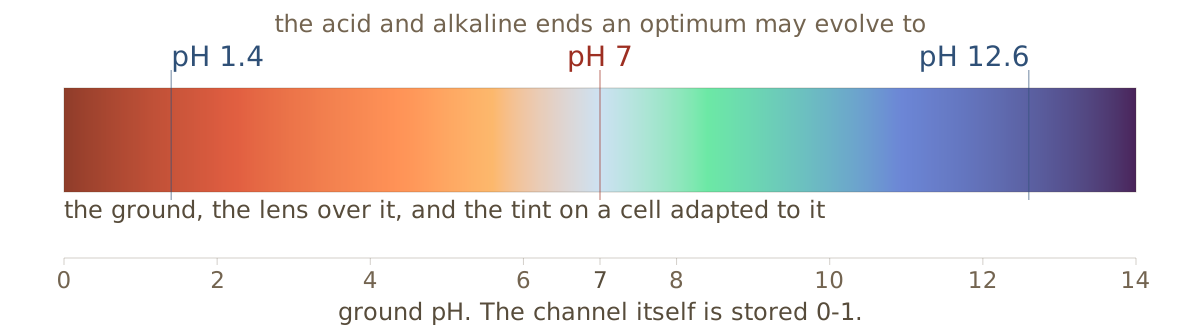
One eight-stop ramp carries pH from acid to alkaline. The ground is painted with it, the
environment lens redraws the dish from it, and the environment bar in the HUD draws the same ramp.
The one ramp every pH surface samples: the ground, the lens over it, the tint on a cell, and the HUD bar. Nothing on this axis is hatched, because nothing on it kills.
How much of the ramp a dish shows depends on the pH spread its generation was given, which is
authored per dish. A dish generated close to neutral never leaves the segment between the two stops
flanking neutral, and the rest of the ramp appears only where something has driven the field there.
The lens reads the pH channel alone rather than the tinted ground, and repaints cells from the same
ramp by their own optimum, brighter than the ground: a cell whose hue matches the ground beneath it
is adapted to where it is standing, and one that clashes is adapted to ground somewhere else. A
separate mismatch lens drops the hue and tints every cell by how far its optimum sits from the local
field, on the worse of the pH and temperature axes, so adapted cells go dark and only the maladapted
ones burn.
With no lens open, a cell body carries a pH tint of its own on a three-stop ramp: crimson for an acid
specialist, icy blue-green at neutral, violet for an alkaline one, shifted by the cell’s temperature
optimum.
The strong and mild bands of one polarity aim a mutagen dose at the same optimum. A StrongAcid
compound and an Acid compound of the same tier are the same instruction; the tier alone sets the
distance. The file marks this an implementer’s call pending an owner ruling, so it may change.
The one-band and two-band cuts in the scrap rule are marked untuned in the file. They are the gene’s
natural units rather than measured values, and they decide how much pH breeding it takes to move a
compound one band.
bound to 2 files
Bound to
The source this page's claims were read against, named by symbol and pinned by the
digest of the file it lives in.