The warmth of the ground a cell stands on. A cold floor and a heat ceiling kill outright; between them a cell outside its tolerance band leaks cytosol, and a colony heats the ground it stands on.
Temperature is the warmth of the ground a cell stands on, read from -6°C to 150°C. Every cell
carries a temperature tolerance gene holding the temperature it prefers and how wide a band
around it is safe. Outside that band the cell leaks
cytosol, and the heat side costs far more than the cold. Below
a cold floor and above a heat ceiling it dies outright. Cells make heat as they feed, so the
temperature that kills a culture is often one the culture made.
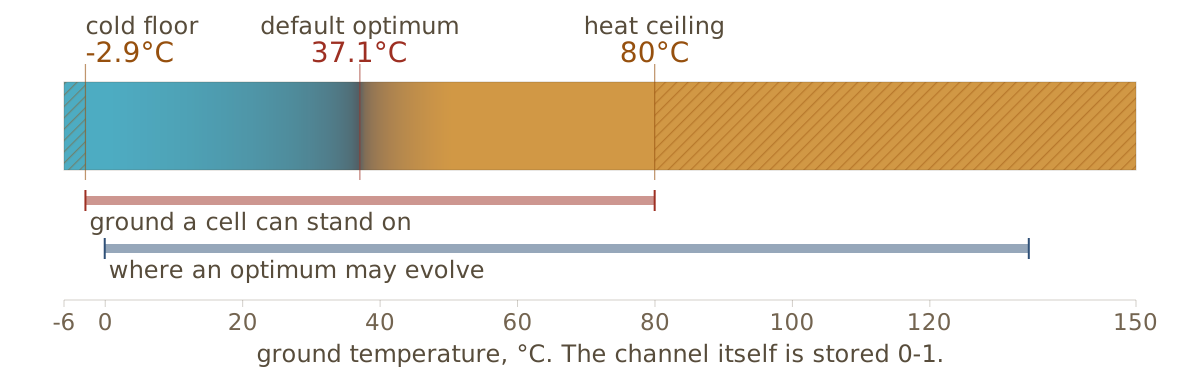
The lens the game paints temperature with, across the whole scale. Both hatched ends kill in the frame they are read. The lower bar is where an optimum may evolve, and it runs well past the heat ceiling.
Cold floor and heat ceiling
Ground at or past either line kills a cell in the frame the value is read, whatever its genome, and
nothing in a genome moves the two lines. Between them temperature is a drain, not an execution.
pH has no equivalent lines: it drains, and never kills in one frame.
Cells stopping all at once instead of thinning indicates ground past one of the two lines.
A cell that runs out of cytosol is labelled by whichever damage source dominated the run-up.
Temperature keeps one signed accumulator for both poles, so a slow freeze reports froze and a
slow cook overheated, the same labels the instant deaths carry. A cell past mid-senescence
reports old age ahead of either, and a death with no dominant source reports as starvation.
Temperature tolerance gene
Every cell has exactly one: mutation can neither delete it nor add a second. It holds two numbers.
Optimum, the temperature the cell prefers, which mutation clamps to roughly 0°C at the cold
end and 134°C at the hot end. Above about 103°C the gene halves the heat half of its own band. The
heat ceiling sits below that point, so the halving shows in the readouts and in what a dose
measures against, rather than in damage.
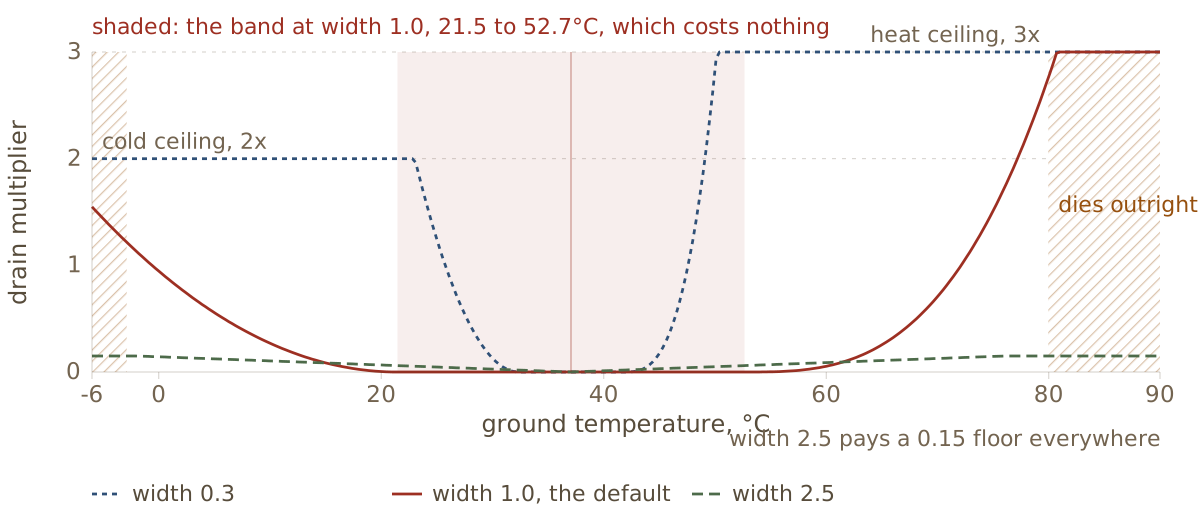
Width multiplier, 0.3 to 2.5, scaling both halves of the band. Below 1.0 the band narrows.
Above 1.0 the sim charges a residual drain, zero at the cell’s own optimum and at full rate at the
band edge. 1.0 is the only width that takes the full base band with no residual.
Cold damage ramps as the square of the excess past the band, capped at 2x; heat ramps as the cube,
capped at 3x. Either drain scales with the cell’s cytosol capacity and its membrane permeability.
The two ramps at three band widths, for a cell sitting at the default optimum. The heat side runs into the dish's ceiling before it reaches its own.
Stress costs twice, on either side of the band. A stressed cell’s mitochondria fade toward a floor
multiplier on cytosol gain while its consumption is not throttled, so it keeps pulling nutrients
and wasting them. Lost income, not the drain, is usually what empties the pool.
Colony heat
Metabolic work deposits heat into the substrate field around
each cell, and it diffuses and decays back toward the culture’s ambient setting. A cluster holds a
warmer patch than the dish would carry; losing cells drops the patch, and more cells cross the floor.
Heat scales with the cytosol produced, superlinearly with mitochondrial efficiency, and with the
cell’s own optimum, so a thermophile warms its ground most and a cold-adapted lineage least. A
nucleus at the mitosis threshold adds more. Pseudopods and
slime-mold networks spread the same total heat over a wider footprint, lowering the peak at the body
without lowering the sum. Losing every mitochondrion is no exit: the fermentation path emits waste
heat at a raised rate per unit of growth.
A mitochondrion gene carries a rare toggle, the cryochondrion, that inverts that organelle’s
heat output, so a cell holding a mix heats and cools at once.
Past a small deadband, hot ground pushes the fluid outward and cold ground draws it in.
Crystals and compounds
Exothermic crystals drive the channel to the top of the scale and endothermic ones to the bottom,
which is below the cold floor. A crystal placed in play sheds drifting molecules, so its aura
travels on the current and reaches past its body: chilling a rival’s ground kills player-owned cells
inside it. Removing one by hand snaps its aura back to ambient; letting it dissolve leaves the
temperature behind.
Two compound rows drive the channel deliberately, Thermogen
and Cryogen, and Cryogen also arms the cryochondrion switch.
Adapting to the ground
Every division steps the optimum toward the temperature at the point of division. The weighting runs
from 3:1 at the edge of the deadzone up to 8:1, with steps that go with the ground enlarged as well,
so the further the ground sits from the reference the harder it pulls. That reference is 37°C, not
the cell’s own optimum: within roughly 8°C of 37°C nothing is aimed at all, and on colder ground
every division is pushed downward wherever the optimum already sits. Extreme temperature also raises
how large and how often mutations land across the genome.
Double-clicking a cell’s nucleus buys a paid dose, which aims the drift. A dose closes 21.6% to
38.5% of the remaining gap to the local temperature per dosed division, four to eight divisions to
arrive. On ground whose spread is wider than the narrower half of the band it widens the band
instead. One or the other, never both.
Past a stress threshold a motile cell flees down the gradient of its own thermal stress, at a
survival floor plus its evolved flee response. The response is clamped non-negative, so a lineage
can evolve stoicism but never attraction to the stress.
Contaminants and seeded rivals arrive retargeted onto the
dish’s ambient, band width pinned back to the default rather than whatever their spawn
mutations rolled.
Climates and board nodes
A culture climate is a centre and a spread: the centre is both the average of the generated field
and the value it decays back toward. Six presets exist: TEMPERATE, COLD, GLACIAL, HOT, THERMAL and
VARIABLE, of which only TEMPERATE is ungated. GLACIAL makes the coldest ground of the six;
VARIABLE keeps the temperate average with the widest spread on offer, so its cold veins run colder
than COLD’s on a dish whose headline reads temperate. No preset reaches the floor.
Board nodes do. A node’s ambient is rolled from a range reaching far below anything the presets
offer, and its spread with it. A node’s dish also carries a cold pole, a fixed bearing along
which the ground cools from the dish’s centre out to its rim, stronger the further out the node sits
on the board. The pole is capped at the headroom above a fixed node floor, so a node already at that
floor gets none, though its own terrain spread still carries ground below it. The board’s strain
readout tests both axes against every deployable strain, and temperature alone can put a node out
of reach.
Contracts ask for thermophiles and psychrophiles by optimum
against 37°C, and the exchange pays for a far optimum held
in a narrow band.
The article states the shape of the tolerance band and no figure for its width, on purpose. There
are two widths in the build and they disagree.
The gene holds its own base cold and heat ranges as constants, asymmetric, with the cold side about
three times the heat side. Every readout reads those: the comfort band, the “prefers X to Y” hint,
the stress badge, the board’s strain fit. The sim does not. The GPU damage path and the
mitochondrial throttle both take their base ranges from the dish’s energy tuning, which is authored
on the scene, and the scene ships the two sides equal.
A strain’s stated band and the band it is actually drained against are not the same band, and the
readout is the narrower and more lopsided of the two. The direction the readout points is reliable;
its edges are not. Any width quoted on this page would be a width nobody plays against.
A cryochondrion is easy to call damage. It cools the ground its own cell is standing on, in
proportion to how well that cell is eating, and on every measure available it leaves the lineage
worse off.
Cold, however, is the one condition a rival adapted to warmth cannot follow a lineage into. A strain
arranging to be uncomfortable in a way nothing around it tolerates at all has not lost a contest; it
has changed which contest is being held. Two things in the build read that way rather than as a
defect: the flip is not only a rare accident but something a named compound arms on purpose, and the
exchange multiplies the price of a line carrying it instead of discounting it.
None of that shows what the arrangement is for, and none of it is mechanics. It says only that a
strain which makes cold is building ground rather than fleeing it, and that the game prices it that
way.
Drift on this axis is not neutral. The gene’s comment defends the log-space step for keeping the
value off the 0.038 and 0.9 walls. It does that, and it still leaves an attractor between them.
The temperature optimum takes a multiplicative step: the value is multiplied by the exponential of a
symmetric roll, so the walk is symmetric in log space, not in degrees. A symmetric walk between the
two clamps therefore settles around their geometric mean rather than their midpoint, which on this
gene’s range sits well below the 37°C a starter ships with. Nothing damps it at division: the
per-division settings ship with near-bound weighting off.
This is the same defect the sibling pH axis documents and was moved off: optimal pH was switched to
an additive step precisely because the multiplicative form drifted whole populations toward the low
wall with no environmental cause. Temperature was left on the multiplicative form.
In practice, on ground close enough to 37°C that the environmental weighting is skipped, a lineage
still cools over generations, and it is drift doing it, not selection. A downward optimum on a
temperate dish is not evidence the dish is cold.
bound to 2 files
Bound to
The source this page's claims were read against, named by symbol and pinned by the
digest of the file it lives in.